Marionette Lines: Filler, Biostimulators, or Structural Support?
Marionette Lines: Filler, Biostimulators, or Structural Support?
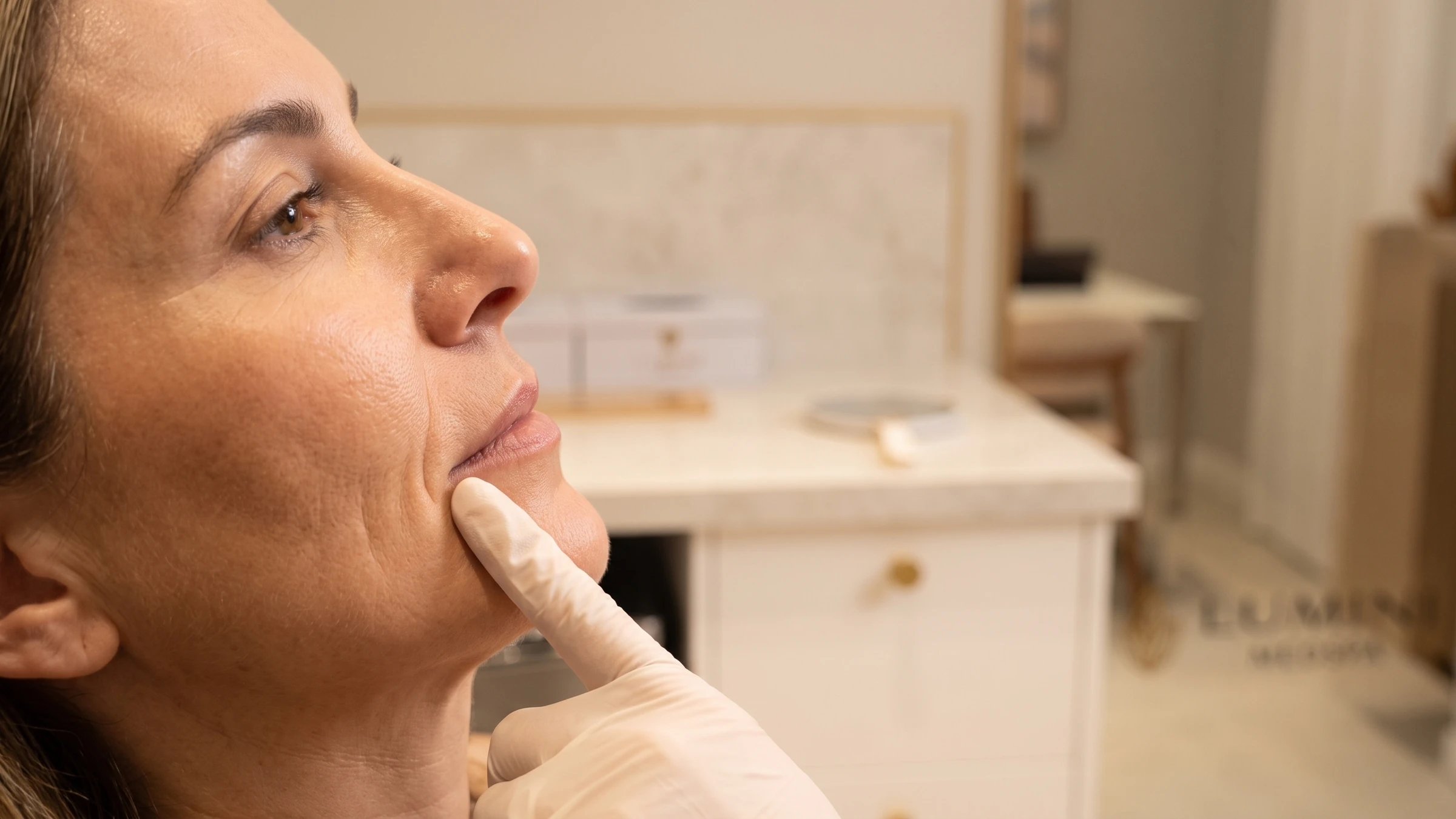
Marionette lines are the vertical creases that extend from the corners of the mouth down toward the chin. While often grouped casually with other facial wrinkles, they represent a distinct anatomical challenge compared to nasolabial folds. Understanding the specific etiology of these lines is essential for developing a safe and effective treatment plan. At Lumini Medical Spa, located within Aventura Mall under physician supervision, we prioritize a diagnostic approach that distinguishes between simple skin creasing and deeper structural deficits. The goal is not merely to fill a line, but to restore facial harmony by addressing the underlying causes of tissue descent, volume loss, and muscular activity.
Distinguishing Marionette Lines from Nasolabial Folds
A common misconception in aesthetic medicine is treating marionette lines as an extension of nasolabial folds. Anatomically, these are distinct entities with different vectors of aging. Nasolabial folds run diagonally from the side of the nose to the corner of the mouth, primarily resulting from the descent of the midface and the accumulation of soft tissue in the upper cheek. In contrast, marionette lines originate at the oral commissure (the corner of the mouth) and travel vertically or obliquely downward toward the jawline.
The distinction matters because treatment planning differs by anatomy. In some patients, midface or lower-face support may be considered instead of—or in addition to—direct treatment of a crease. Addressing only the visible line without considering the chin, prejowl area, skin quality, and tissue distribution may produce an unbalanced result. A comprehensive assessment should evaluate the relative contribution of skin laxity, soft-tissue volume, skeletal structure, and dynamic muscle pull.
The Multifactorial Etiology of Marionette Lines
Marionette lines are rarely caused by a single factor. Instead, they typically arise from a combination of age-related changes that alter the lower face’s architecture.
Volume Loss and Tissue Descent
Age-related changes can affect facial fat compartments, retaining ligaments, skin, and skeletal support. In the lower face, changes around the chin and prejowl area can alter shadows and make a marionette line more visible. The pattern and relative contribution of each layer differ among patients.
Chin and Prejowl Support
Chin projection and mandibular support may contribute to the appearance of the lower face. In selected patients, assessment of the chin and prejowl area can be relevant to treatment planning. This does not mean that structural filler is required or preferable for every marionette line.
Depressor Activity
Dynamic muscle activity can contribute to the formation and deepening of these lines. The depressor anguli oris (DAO) muscle pulls the corners of the mouth downward, particularly during expression and, in some people, at rest. Over time, repeated movement can contribute to lines that remain visible without expression. Fillers can add volume, but they do not directly reduce an active muscular pull.
Skin Quality and Texture
Finally, intrinsic aging affects the quality of the dermis. A reduction in collagen and elastin leads to thinner, less resilient skin that is more prone to folding and creasing. Even if volume is restored, poor skin quality can result in a lack of smoothness over the treated area.
Why Direct Filler Injection Is Not Always the Best Strategy
There is a prevailing belief that marionette lines should be treated by injecting filler directly into the groove. However, this “filling the line” approach has limitations and potential risks. Injecting directly into a deep vertical crease can sometimes create a visible lump or an unnatural bulge if the volume is not perfectly integrated with the surrounding tissue. Furthermore, filling the line without addressing the structural deficit above it may result in a “floating” appearance where the filled area does not blend seamlessly with the jawline.
One possible strategy in appropriately selected patients is structural support away from the deepest part of the crease. Depending on the anatomy, treatment planning may consider the chin, prejowl region, mandibular contour, or the crease itself. No placement strategy is universally appropriate, and the plan should be individualized after in-person assessment.
Treatment Modalities: A Comparative Overview
Hyaluronic Acid (HA) Fillers
Hyaluronic acid (HA) fillers may provide immediate volume correction or structural support in selected patients. Their behavior depends on the exact product, tissue plane and anatomy. HA filler may be amenable to treatment with hyaluronidase when clinically appropriate, but the degree and speed of response cannot be guaranteed. Hyaluronidase does not dissolve non-HA fillers or biostimulators.
Biostimulators
Biostimulatory agents, such as poly-L-lactic acid (PLLA) or calcium hydroxylapatite (CaHA), differ from HA fillers in composition, behavior, and reversibility. Depending on the product and how it is used, they may support gradual collagen-related improvement in selected patients. They do not correct every cause of marionette lines, are not dissolved by hyaluronidase, and require individualized product selection, treatment planning, and counseling about the expected course.
Conservative Neuromodulator Use
In cases where the depressor anguli oris (DAO) muscle is hyperactive, a conservative application of neuromodulators may be considered. By relaxing the muscle that pulls the mouth corners down, the tension on the marionette lines can be reduced. This approach must be used with extreme caution; over-treatment can lead to an unnatural smile or difficulty with oral function. The goal is subtle relaxation, not paralysis.
Device Limitations
Energy-based devices and injectables address different tissue characteristics and carry different risks. A device may be considered when skin quality is part of the concern, but it does not replace missing structural volume. Conversely, an injectable does not reproduce the skin-remodeling effect of an energy-based treatment. Either may be used alone, in sequence, or not at all depending on the assessment.
When to Leave the Line Untreated
Not every marionette line requires intervention. In some individuals, these lines are a natural part of facial expression and character. Excessive correction can create an overfilled or unbalanced lower face. A conservative plan may therefore prioritize overall facial balance instead of trying to erase every line.
Safety Considerations and Emergency Protocols
The lower face contains a complex network of blood vessels, and filler injection can cause serious complications. Vascular occlusion can occur if product compromises blood flow and may lead to tissue injury or necrosis. Vision loss is a rare but potentially catastrophic complication reported with facial filler injections.
At Lumini Medical Spa, filler treatment requires individualized anatomical assessment, informed consent and readiness to recognize and respond to complications. Vascular occlusion is a known risk of dermal filler injection, even when treatment is performed carefully.
Suspected vascular occlusion requires urgent in-person assessment and treatment. When HA filler is involved, management may include hyaluronidase, but no intervention should be described as guaranteed to restore blood flow or prevent injury. Non-HA fillers and biostimulators are not dissolved by hyaluronidase, making product identification and prompt escalation important.
Frequently Asked Questions
1. Are marionette lines the same as nasolabial folds?
No. Nasolabial folds run from the nose to the mouth corner, while marionette lines run from the mouth corner down toward the chin. They have different causes and often require different treatment strategies.
2. Can fillers permanently remove marionette lines?
Not necessarily. Longevity differs by product, location, technique, and patient, and some filler materials may persist longer than their visible effect. Results change over time as the product and facial tissues evolve. Any decision to repeat treatment should follow reassessment rather than a preset maintenance schedule.
3. Is it safe to inject fillers in the lower face?
No filler injection is risk-free. The lower face has complex vasculature, and vascular occlusion and other adverse events can occur even with careful treatment. A qualified licensed injector, appropriate medical oversight, informed consent, and readiness to recognize and manage complications are important safeguards.
4. What happens if I have a complication with my filler?
If vascular occlusion is suspected after HA filler, urgent evaluation and treatment may include hyaluronidase. Response is not guaranteed, and non-HA fillers do not have this reversal option.
5. Do biostimulators work better than traditional fillers for marionette lines?
Biostimulators and HA fillers differ in composition, behavior, reversibility, and intended role. Either may be inappropriate depending on the cause of the crease, anatomy, medical history, and goals. The choice should follow an in-person assessment rather than a general claim that one category works better.
6. Can neuromodulators help with marionette lines?
It may be considered when depressor muscle activity contributes to the concern. This requires careful assessment because weakening the wrong muscle or treating an unsuitable pattern can affect smile function.
7. How do I know if I need structural support instead of just filling the line?
An in-person assessment is needed to identify which anatomical layers contribute to the line. Depending on the findings, a clinician may discuss the chin, prejowl area, skin quality, muscle activity, direct treatment of the crease, a combination approach, or no treatment.
References
- U.S. Food and Drug Administration. Dermal Fillers (Soft Tissue Fillers). https://www.fda.gov/medical-devices/aesthetic-cosmetic-devices/dermal-fillers-soft-tissue-fillers
- Burgess C, Dayan S, Bank D, et al. Hyaluronic acid filler VYC-25L for jawline restoration yields high satisfaction, improved jawline measurements, and sustained effectiveness across skin types, age, and gender for up to 12 months. Aesthetic Surgery Journal. 2024;45(1):98-107. PMID: 39141784. https://pubmed.ncbi.nlm.nih.gov/39141784/
- Dayan SH, Hartman CL, Di Gregorio C, et al. Aesthetic improvement, facial harmony, and patient satisfaction after lower face treatment with a hyaluronic acid filler: a randomized post-marketing study. Journal of Clinical and Aesthetic Dermatology. 2025;18(10):48-54. PMID: 41416028. https://pubmed.ncbi.nlm.nih.gov/41416028/
- David M, Braccini F, Garcia P, et al. Long-term efficacy and tolerability of a medium G′ HA filler with Tri-Hyal technology on the rejuvenation of the mobile facial zone. Clinical, Cosmetic and Investigational Dermatology. 2023;16:1795-1805. PMID: 37465030. https://pubmed.ncbi.nlm.nih.gov/37465030/
- Braz A, Eduardo CCP. Reshaping the lower face using injectable fillers. Indian Journal of Plastic Surgery. 2020;53(2):207-218. PMID: 32884187. https://pubmed.ncbi.nlm.nih.gov/32884187/
- Signorini M, Fundarò SP, Bertossi D, et al. OnabotulinumtoxinA from lines to facial reshaping: a new Italian consensus report. Journal of Cosmetic Dermatology. 2022;21(2):550-563. PMID: 35060310. https://pubmed.ncbi.nlm.nih.gov/35060310/
Related Resources
For more information on treating smile lines and nasolabial folds, please visit our guide on nasolabial folds and smile lines in Aventura. To understand the different types of injectables available, review our comprehensive dermal fillers guide for Aventura. Patients interested in collagen-stimulating treatments may find our comparison of Sculptra vs. Radiesse helpful. For those looking to enhance their lower face contour, explore our page on non-surgical jawline contouring in Aventura. If you have concerns about filler safety or reversal, read our guide on hyaluronidase and dissolving fillers. To schedule a consultation with our physician-supervised team, please contact us.
Medically reviewed by Dr. Caio Trentin, MD, Physician, Lumini Medical Spa. Educational information only. It does not replace an in-person assessment. Individual results vary.