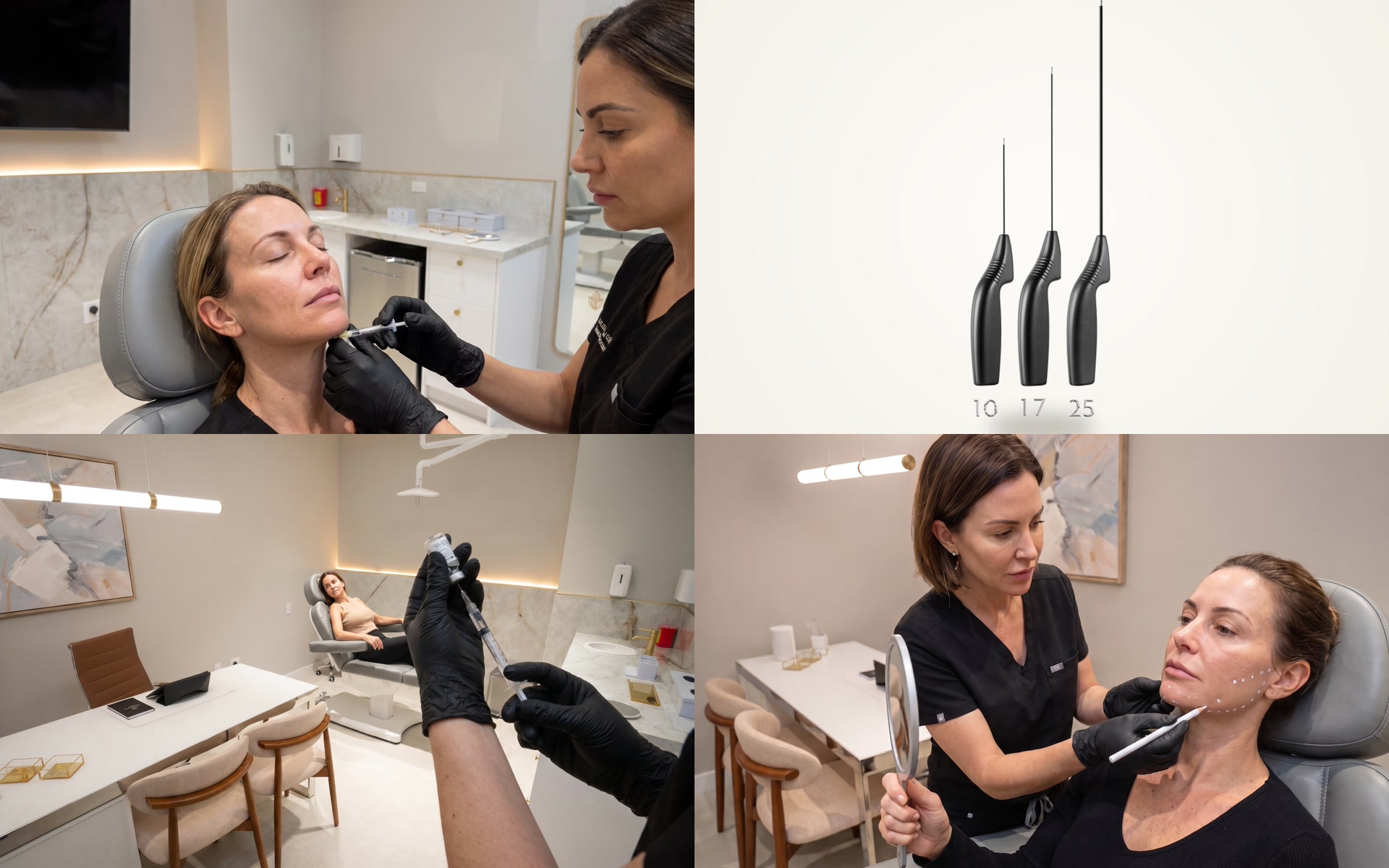
Jawline Contouring Without a Facelift: Match the Treatment to the Cause
Fat, laxity, volume loss and tissue descent can blur the same jawline — but they do not respond to the same procedure.
Jawline Contouring Without a Facelift: Match the Treatment to the Cause
A softer jawline can come from fat below the chin, loose skin, limited chin projection, loss of structural support, descended tissue, muscle anatomy – or several layers at once. The visible complaint may be the same, but the treatment plan should not be.
This is why “best jawline treatment” is the wrong starting question. The useful question is: what is obscuring the mandibular border in this patient?
Start with the layer, not the device
| Main finding | What may fit | What it does not directly fix |
|---|---|---|
| Localized submental fat | Kybella in an appropriate adult candidate with pinchable pre-platysmal fat. | Significant skin laxity, a recessed chin or descended lower-face tissue. |
| Limited chin or jawline projection | An anatomically appropriate, FDA-approved dermal filler for the selected site. | Submental fat or true skin tightening. |
| Mild-to-moderate tissue descent | PDO threads in a carefully selected physician-treated patient. | Fat removal, skeletal projection or surgical-level lifting. |
| Submental skin laxity | Energy-based remodeling; QuantumRF is a minimally invasive subdermal procedure, not a facial. | A large fat compartment, severe laxity or skeletal deficiency by itself. |
| Multiple layers | A staged combination after anatomy and recovery are reassessed. | A one-size-fits-all package selected before examination. |
Kybella: when the problem is submental fat
Kybella is deoxycholic acid and is FDA approved to improve moderate-to-severe convexity or fullness associated with submental fat in adults. It is not established or recommended for fat outside the submental region.
A correct assessment confirms that enough pre-platysmal fat is present and considers other causes of fullness. The prescribing information specifically advises caution when excessive skin laxity or prominent platysmal bands could produce an undesirable result after fat reduction.
Swelling is expected and may be prominent. Other common reactions include bruising, pain, numbness, redness and firmness. Material risks include marginal mandibular nerve injury, which can produce an asymmetric smile, dysphagia, tissue injury, vascular injury, ulceration and necrosis. The label permits up to six treatments at intervals of at least one month, but the actual plan is individualized.
Dermal filler: when the problem is projection or structure
Hyaluronic acid filler can add volume and shape to selected areas of the chin or jawline. It can improve the profile or create a cleaner transition along the mandibular border when the problem is insufficient projection or structural support.
Filler does not dissolve fat and does not contract loose skin. Adding volume to the wrong patient can make the lower face look heavier. Product selection also matters because FDA approvals are product- and site-specific. For example, Restylane Defyne is FDA approved for chin augmentation in adults over 21; that approval should not be generalized to every filler or every jawline injection pattern.
Temporary swelling, bruising, tenderness, redness and lumps can occur. The most serious risk is accidental injection into a blood vessel, which can cause tissue necrosis, vision abnormalities including blindness, or stroke. Filler is a medical procedure requiring appropriate product, anatomy knowledge and complication readiness.
PDO threads: when selected tissue can be repositioned
PDO thread lifting uses absorbable sutures to create a temporary mechanical lift and a healing response around the treatment path. In the lower face, it may improve contour when mild-to-moderate tissue descent is the dominant issue and expectations are realistic.
Threads do not reproduce a surgical facelift and do not remove submental fat. They also do not correct a small or recessed chin. A 2026 meta-analysis of 26 studies involving 2,827 patients reported substantial variability, with swelling, bruising, visible or palpable threads and skin dimpling among the observed complications. Careful selection and technique remain central.
At Lumini, thread lifting is a physician-only procedure. The number and vector of threads should follow the anatomy rather than a preset social-media pattern.
QuantumRF: when the issue includes submental laxity
QuantumRF is a minimally invasive subdermal radiofrequency procedure performed through small access points under tumescent anesthesia. It delivers energy beneath the skin to support tissue contraction and remodeling. It should not be described as non-invasive, RF microneedling or a no-downtime facial.
Evidence from minimally invasive, temperature-controlled monopolar radiofrequency studies supports potential improvement in selected mild-to-moderate submental laxity, but results are device-, technique- and patient-specific. One prospective 72-subject study reported improvement through six months; it was single-center and supported by an industry grant, so it should not be treated as proof that every RF device or patient will produce the same outcome.
Energy-based tightening does not create skeletal projection, and severe laxity may still be better addressed surgically. The consultation should clarify whether the goal is modest contraction, fat reduction, repositioning or a combination.
When a combination makes sense
Combination planning should be staged when one procedure materially changes the anatomy or swelling pattern used to judge the next. A package is not a diagnosis.
Recovery and timing
| Option | Common early recovery | Planning reality |
|---|---|---|
| Kybella | Swelling, bruising, pain, numbness and firmness are common. | Multiple sessions may be needed; the result cannot be judged during peak swelling. |
| Filler | Swelling, tenderness and bruising may occur. | Usually visible immediately, but early swelling is not the final contour. |
| PDO threads | Swelling, bruising, soreness, asymmetry or dimpling may occur. | Early lift and settling change over time; visible or palpable threads can occur. |
| QuantumRF | Swelling, bruising, tenderness and temporary sensory changes may occur. | Remodeling evolves over time; the procedure is minimally invasive and requires a recovery plan. |
Current Lumini cost context
These figures are menu prices, not treatment quotes. Total cost depends on the diagnosed layer, amount of product or number of threads, number of sessions and whether a staged combination is appropriate. Current public pricing should be checked on Lumini’s pricing page and confirmed during consultation.
Pricing checked against the active Phorest catalog on August 22, 2026. Prices may change.
How Lumini evaluates the jawline
- Examine the chin, mandibular border, submental fat, skin quality, platysma and degree of tissue descent from front, profile and oblique views.
- Separate what can be reduced, supported, repositioned or tightened.
- Identify when a minimally invasive plan is unlikely to match the desired degree of change.
- Choose one primary target, then reassess before adding another modality.
Frequently asked questions
How can I tighten a sagging jawline without surgery?
That depends on the degree and layer of laxity. Selected mild-to-moderate laxity may be addressed with energy-based remodeling or temporary tissue repositioning. Severe laxity may not respond enough to justify repeated minimally invasive procedures.
Is Kybella or filler better for a jawline?
They solve different problems. Kybella reduces selected submental fat; filler adds structure or projection. Using one for the other’s target can worsen the contour.
How risky is jawline filler?
Common effects include swelling and bruising. Rare vascular occlusion can cause tissue loss, blindness or stroke, which is why product selection, anatomy knowledge and emergency readiness matter.
How long does jawline filler last?
Duration depends on the specific product, treatment site, amount, anatomy and metabolism. FDA data for Restylane Defyne chin augmentation showed improvement in many patients through 48 weeks, but that cannot be generalized to every jawline product or injection pattern.
Does Kybella tighten loose skin?
No. Kybella targets submental fat. The prescribing information specifically advises careful consideration in patients with excessive skin laxity because reducing fat may not produce a desirable contour.
Are PDO threads permanent?
No. PDO threads are absorbable and the lifting effect is temporary. Longevity varies with tissue, technique, vector and healing response.
Is QuantumRF non-surgical?
It avoids a traditional facelift incision, but it is a minimally invasive subdermal procedure performed through small access points under tumescent anesthesia. “Non-invasive” would be inaccurate.
Can I combine Kybella, filler, threads and RF?
Potentially, but not because every jawline needs every modality. A staged plan may be appropriate when different layers contribute, with recovery and anatomical change reassessed before the next step.
References
- U.S. Food and Drug Administration. KYBELLA (deoxycholic acid) prescribing information. FDA label.
- U.S. Food and Drug Administration. Using Fat-Dissolving Injections That Are Not FDA Approved Can Be Harmful. FDA.
- U.S. Food and Drug Administration. Dermal Fillers (Soft Tissue Fillers). FDA.
- U.S. Food and Drug Administration. Restylane Defyne – P140029/S027. FDA.
- Zhou X, Zhuang S. A meta-analysis of complications of thread lifting. Front Surg. 2026;13:1769458. PubMed.
- Turer DM, James IB, DiBernardo BE. Temperature-Controlled Monopolar Radiofrequency in the Treatment of Submental Skin Laxity: A Prospective Study. Aesthet Surg J. 2021;41(11):NP1647-NP1656. PubMed.
Related treatment guides
- Kybella in Aventura
- Restylane in Aventura
- PDO thread lift in Aventura
- QuantumRF in Aventura
- Threads vs. filler for the jawline
- Kybella double-chin guide
- Current Lumini pricing
Medically reviewed by Dr. Caio Trentin, M.D., Physician, Lumini Medical Spa. Educational information only. It does not replace an in-person assessment. Individual results vary.