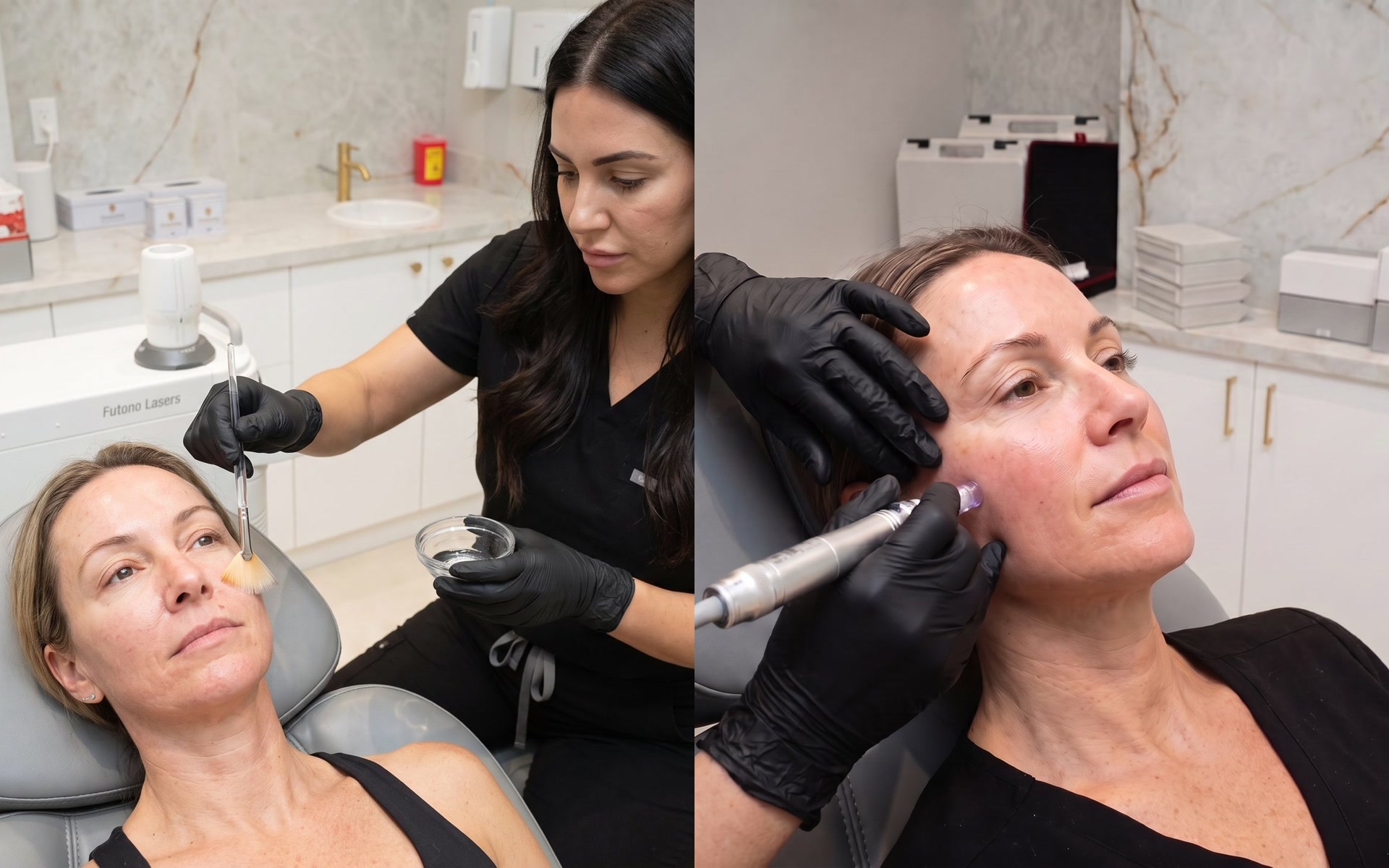
Chemical Peel vs. Microneedling: Which Is Better for Your Skin?
A concern-by-concern comparison for dark spots, acne scars, pores, fine lines, downtime and skin tone.
Chemical Peel vs. Microneedling: Which Is Better for Your Skin?
A patient can describe both a brown mark and a depressed scar as an “acne scar,” but those are different targets. A flat post-acne mark is pigment. A rolling or boxcar depression is a structural change in the dermis. Treating the label instead of the tissue is one reason patients can complete a series and still feel that the wrong problem was addressed.
At Lumini Medical Spa in Aventura, the practical question is therefore not simply “peel or microneedling?” It is: what layer is creating the concern, and what amount of controlled injury is appropriate for this skin?
How the treatments differ
| Decision point | Chemical peel | Microneedling |
|---|---|---|
| Primary action | A controlled chemical exfoliation whose depth depends on the agent, concentration, application and skin response. | Controlled mechanical micro-injury intended to stimulate repair and collagen remodeling. |
| Often considered for | Dullness, selected superficial pigmentation, active-acne protocols and fine surface texture. | Atrophic acne scars, uneven texture and selected facial wrinkles. |
| What changes the result | Peel chemistry and depth, preparation, contact time, skin type and aftercare. | Device authorization, needle depth, technique, number of passes, treatment interval and aftercare. |
| Typical recovery pattern | Redness, tightness and flaking vary substantially with peel depth. | Redness, tightness, swelling, pinpoint bleeding or peeling may occur; duration varies with depth and response. |
| Key avoidable risk | Excessive depth or unsupervised acid use can cause burns, scarring and pigment change. | Improper technique or cartridge reuse can cause infection, tissue injury, scarring and pigment change. |
Which is better for acne scars?
For atrophic scars – depressions such as rolling, boxcar or ice-pick scars – microneedling is frequently considered because its treatment signal reaches the dermis. One randomized study of 60 patients with Fitzpatrick skin types IV through VI found a greater proportion improved by more than one scar grade after microneedling than after 35% glycolic acid peels. That result is useful, but it does not make microneedling universally superior.
A 2026 systematic review and meta-analysis found a more nuanced picture. Microneedling increased the likelihood of achieving at least a one-grade improvement, but there was no clear difference between microneedling and chemical peels for the stricter endpoint of at least 50% improvement. Certainty ranged from moderate to very low depending on the outcome, and protocols varied widely.
Scar morphology still matters. A tethered rolling scar, sharply edged boxcar scar and narrow ice-pick scar may require different strategies. Neither a standard full-face peel nor routine microneedling should be presented as the answer to every scar type.
Which is better for dark spots and post-acne marks?
For flat, superficial discoloration, a properly selected chemical peel may be the more direct tool because it targets epidermal turnover. Randomized studies have evaluated glycolic, salicylic and Jessner-type peels for acne and post-acne pigmentation, but the evidence does not justify promising complete clearance.
Microneedling may be discussed when pigment coexists with dermal texture, but it is not simply a deeper “spot treatment.” Both treatments can provoke post-inflammatory hyperpigmentation, particularly when inflammation is excessive or aftercare and photoprotection are inadequate.
Melasma deserves extra caution. It is recurrent and biologically different from a simple post-acne mark. A procedure may be one component of a plan, but no peel or needling series should be sold as a permanent cure.
Which is better for pores, texture and fine lines?
Downtime, comfort and safety
A peel may produce warmth or stinging during application, followed by tightness, redness and visible flaking. The intensity and duration depend on the peel. Microneedling is commonly performed after topical numbing and may produce redness, swelling, pinpoint bleeding, dryness or peeling.
The FDA has authorized specific microneedling devices for specific indications, including facial acne scars and facial wrinkles in adults 22 and older. It has not authorized microneedling devices to deliver cosmetics, drugs, vitamins or blood products into the skin. Device identity, cartridge handling and operator training matter.
The FDA also warns against purchasing or applying higher-concentration chemical peel products without appropriate professional supervision because chemical burns can lead to infection, pigment changes, scarring and disfigurement.
Can chemical peels and microneedling be combined?
They can be part of the same treatment strategy, but “combination” does not automatically mean “same appointment.” Studies of combined protocols for acne scars suggest a potential advantage over either modality alone, yet the published protocols differ and do not remove the risk of excessive inflammation or pigment change.
The conservative approach is to define the target, choose the sequence and reassess skin recovery before the next controlled injury. The timing, peel selection and microneedling depth should be individualized rather than copied from a generic calendar.
Current Lumini menu and cost context
Lumini currently lists four chemical peel options and several microneedling treatment areas. The correct service is selected after skin assessment; price alone should not determine peel depth or needle depth.
Pricing checked against the active Phorest catalog on August 22, 2026. Final pricing and candidacy are confirmed during consultation. Prices may change.
How Lumini makes the choice
- Separate pigment, active acne, scar depth, texture and laxity instead of treating them as one concern.
- Assess Fitzpatrick skin type, recent tanning, inflammatory disease, medications, healing history and tendency toward pigment change or keloids.
- Choose the least aggressive treatment likely to reach the correct layer.
- Define how response will be photographed or measured before escalating or combining treatments.
Frequently asked questions
Should I do a chemical peel or microneedling first?
The sequence depends on the primary concern and skin condition. If active inflammation or superficial pigment is dominant, a provider may begin with skin stabilization or a selected peel. If depressed scarring is dominant and the skin is ready for controlled injury, microneedling may be considered first.
Which is better for acne scars?
For atrophic depressions, microneedling often has the more direct rationale, but scar type matters and pooled evidence does not show universal superiority across every outcome. Flat post-acne marks are pigment rather than atrophic scars and may require a different plan.
Which is better for hyperpigmentation?
A selected superficial peel may directly address epidermal discoloration. Both procedures can worsen pigment if inflammation is excessive, so skin type, diagnosis, preparation and photoprotection are central to the decision.
Which treatment has less downtime?
There is no single answer because peel depth and microneedling depth vary. A light peel may cause brief flaking; a stronger peel may require longer recovery. Microneedling commonly causes short-term redness and swelling, but deeper treatment can extend recovery.
Can I have a chemical peel after microneedling?
Only after the skin has recovered and the treating clinician has selected an appropriate interval and peel. Applying acids to incompletely healed skin can increase irritation and injury risk.
Can the treatments be performed together?
Published acne-scar studies have evaluated combined protocols, but that does not make same-day treatment appropriate for every patient. Combination treatment should be deliberate, not automatic.
Are these treatments safe for darker skin tones?
Both can be used in appropriately selected patients, but post-inflammatory hyperpigmentation remains a material risk. Conservative parameters, correct diagnosis, sun avoidance and aftercare are especially important.
How many sessions will I need?
There is no universal series. The number depends on the target, severity, treatment depth, response and tolerance. Progress should be reassessed rather than selling an automatic fixed series.
References
- Agu-Jefferson I, et al. Microneedling Versus Chemical Peels for Atrophic Acne Scars: A Systematic Review and Meta-Analysis. Cureus. 2026. PubMed.
- Ishfaq F, et al. A Comparison of Microneedling versus Glycolic Acid Chemical Peel for the Treatment of Acne Scarring. J Clin Aesthet Dermatol. 2022;15(6):48-52. PubMed.
- Ali BME, et al. Microneedling (Dermapen) and Jessner’s solution peeling in treatment of atrophic acne scars: a comparative randomized clinical study. J Cosmet Laser Ther. 2019. PubMed.
- El-Domyati M, et al. Microneedling combined with platelet-rich plasma or trichloroacetic acid peeling for management of acne scarring. J Cosmet Dermatol. 2018;17(1):73-83. PubMed.
- U.S. Food and Drug Administration. Microneedling Devices: Benefits, Risks and Safety. FDA.
- U.S. Food and Drug Administration. FDA warns against purchasing or using chemical peel skin products without professional supervision. FDA.
- Mar K, et al. Treatment of Post-Inflammatory Hyperpigmentation in Skin of Colour: A Systematic Review. J Cutan Med Surg. 2024. PubMed.
Related treatment guides
- Chemical peels in Aventura
- Microneedling in Aventura
- Chemical peel guide
- Collagen-induction microneedling guide
- Microneedling with PRP vs. without PRP
- Current Lumini pricing
Medically reviewed by Dr. Caio Trentin, M.D., Physician, Lumini Medical Spa. Educational information only. It does not replace an in-person assessment. Individual results vary.