Microneedling With PRP vs. Without PRP: Is the Add-On Worth It?
TREATMENTS
Microneedling With PRP vs. Without PRP
For atrophic acne scars, adding platelet-rich plasma (PRP) to microneedling may improve results compared with microneedling alone. For general glow, fine lines, laxity or broad “anti-aging,” the evidence is much less certain—so the PRP add-on is not automatically worth it for everyone. The right choice depends on what you are treating, the quality of your skin, your tolerance for a blood draw, budget and whether the expected incremental benefit is supported for that specific concern.
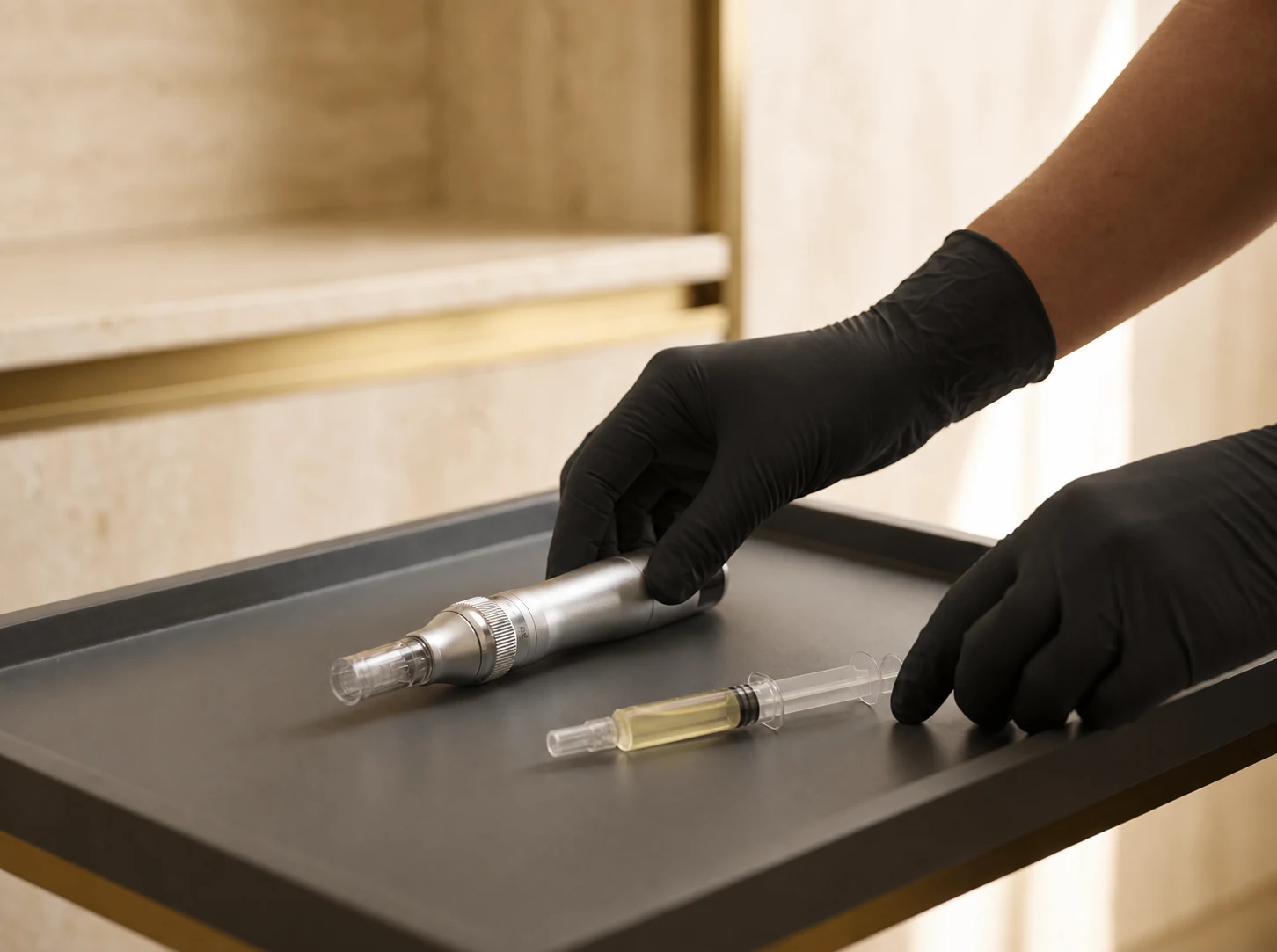
Standard microneedling in Aventura already creates controlled micro-injuries that trigger a wound-healing response and new collagen formation. PRP is prepared from a small sample of your own blood and contains a concentrated portion of platelets and signaling proteins. At Lumini, the PRP serum add-on is applied after the microneedling portion; the microneedling device is not described as injecting PRP.
What changes when PRP is added?
The microneedling step is what creates the controlled channels and mechanical collagen-remodeling signal. Adding PRP introduces autologous—meaning your own—platelets and growth-factor-rich plasma to the freshly treated surface. The biological rationale is that those signals may support tissue repair and remodeling.
That rationale is plausible, but it does not prove that every indication improves meaningfully. PRP studies vary in how blood is processed, platelet concentration, activation method, application technique, number of sessions and outcome scoring. Those differences make a single blanket claim such as “PRP always works better” scientifically weak.
| Question | Microneedling alone | Microneedling + PRP |
|---|---|---|
| Main mechanism | Controlled micro-injury stimulates repair and collagen remodeling | The same microneedling stimulus plus autologous platelet-rich plasma applied afterward |
| Best-supported use | Texture, pores and collagen induction; also used in acne-scar plans | Incremental improvement in atrophic acne-scar outcomes is supported by several pooled analyses |
| Evidence for general rejuvenation | Established procedure, with outcomes varying by protocol and concern | Promising but inconsistent; superiority is not established for every anti-aging goal |
| Extra step | No blood draw or PRP preparation | Requires blood draw, processing and serum application |
| Cost at Lumini | Microneedling pricing is confirmed during consultation | PRP is a separate add-on; pricing is confirmed during consultation |
Where is the evidence strongest?
Atrophic acne scars are the clearest case for considering the add-on. A 2020 systematic review and meta-analysis of 311 participants found that microneedling or subcision combined with PRP produced better acne-scar outcomes than the same procedures without PRP. A separate meta-analysis of controlled studies involving 472 patients also found better clinical improvement and patient satisfaction with the combination, although study methods and outcome scales varied.
A 2024 network meta-analysis of 24 studies and 1,546 participants likewise concluded that combination approaches generally outperformed microneedling alone for acne scars. Importantly, microneedling plus PRP was not the top-ranked option in every analysis; microneedling combined with a chemical peel ranked highest for some outcomes. A 2026 review of 17 studies and 1,111 participants found an advantage for microneedling plus PRP over microneedling alone, while emphasizing small samples, short follow-up and inconsistent scar-grading methods.
Scar morphology matters. Rolling, boxcar and ice-pick scars do not respond identically, and deeper tethered scars may require subcision or another modality. Active acne, pigment risk, recent isotretinoin use, keloid tendency and skin-barrier status can also change the plan. A treatment label cannot replace a scar-specific assessment.
Where is the evidence still uncertain?
The marketing around PRP often jumps from acne-scar studies to claims about glow, fine lines, laxity and “regeneration.” That leap is not fully supported. A systematic appraisal of PRP for facial rejuvenation reviewed 36 studies involving 3,172 patients and concluded that the overall clinical evidence was very limited because of heterogeneous methods and incomplete reporting.
A small randomized, placebo-controlled trial published in 2024 compared PRP injections with saline after whole-face microneedling in 18 women. Investigators did not find evidence of improvement in facial laxity or wrinkles and found no notable difference in roughness. That study does not settle the entire question—it was small and studied injected PRP—but it is a useful counterweight to universal anti-aging claims.
For general rejuvenation, the honest position is therefore narrower: some patients and studies report improvement, but the size and reliability of the additional benefit over microneedling alone are not established well enough to recommend PRP automatically.
When may the PRP add-on be worth it?
- Your primary concern is atrophic acne scarring, and the provider believes microneedling is appropriate for your scar type.
- You understand that PRP may provide an incremental benefit rather than a dramatic transformation.
- You are comfortable with a blood draw and the extra preparation step.
- You want an autologous add-on and do not have a contraindication identified during screening.
- You have already responded to standard microneedling and want to discuss whether a combination plan is justified.
Even in these situations, “worth it” is personal. A statistically better average result does not tell an individual patient how much improvement they will see or whether the additional cost is worthwhile. Photography, consistent treatment intervals and a defined outcome target make that decision more objective.
When may microneedling alone be enough?
- You are new to microneedling and want to measure your response to the standard treatment first.
- Your goals are mild texture irregularity, visible pores or maintenance rather than deeper acne scars.
- You prefer to avoid a blood draw or minimize appointment complexity.
- Your budget is better directed toward completing a consistent series instead of adding PRP to a single isolated treatment.
- Your provider recommends another modality because your scar type or primary concern is unlikely to respond optimally to microneedling.
Consistency often matters more than the most elaborate single session. If the plan calls for a series, completing the correct number of appropriately spaced treatments and following aftercare may deliver more value than selecting every available add-on once.
Safety and the FDA distinction patients should know
The U.S. Food and Drug Administration states that microneedling devices are not cleared or approved specifically for delivering cosmetics, topical medications, vitamin solutions, drugs or blood products such as PRP into the skin. The FDA also notes that the risks associated with combining microneedling devices with other products may be unknown.
That distinction affects how the treatment should be described. Lumini’s service menu defines the PRP add-on as platelet-rich plasma applied after microneedling or laser. We do not claim that the microneedling device injects PRP, and we do not present the combination as an FDA-approved delivery method.
Microneedling can cause temporary redness, tightness, pinpoint bleeding, swelling, dryness or peeling. PRP adds a blood draw and handling step. Screening should cover active infection, uncontrolled skin disease, impaired healing, bleeding risk, relevant medications, pregnancy status when applicable, history of keloid scarring and any condition that changes the safety of an elective procedure. Sterile technique and single-use components are essential.
Microneedling with or without PRP at Lumini
Lumini Medical Spa offers microneedling for the face, neck and décolleté. The PRP serum option is a separate add-on applied after microneedling or laser; its price and appropriateness are confirmed during a personalized consultation. Read our broader microneedling and collagen-induction guide or our detailed guide to PRP facial treatment.
The consultation should end with a specific answer: the concern being treated, why standard microneedling is or is not enough, what additional benefit PRP is expected to provide, how progress will be measured and when the plan should be changed. If those questions cannot be answered, the add-on is not yet justified.
Frequently asked questions
Is microneedling with PRP better than microneedling alone? For atrophic acne scars, pooled research suggests that adding PRP may improve outcomes. For generalized glow, wrinkles or laxity, superiority is not established consistently, so the answer depends on the concern being treated.
What does PRP add to microneedling? PRP adds a concentrated portion of your own platelets and plasma after the controlled microneedling step. The rationale is to provide signaling proteins that may support repair and remodeling.
Does PRP reduce microneedling downtime? Some clinicians and studies report faster recovery, but protocols and definitions vary. It should not be promised. Plan for the aftercare and downtime given for microneedling unless your provider advises otherwise after assessing your skin response.
How many sessions of microneedling with PRP are needed? There is no universal number. The plan depends on the concern, scar type, depth of treatment, response and interval. A series is common for acne scars, but the exact schedule should be individualized.
Is microneedling with PRP a “vampire facial”? The nickname is often used for microneedling followed by topical PRP. Because clinics use the term inconsistently, ask exactly how PRP is prepared and applied rather than relying on the nickname.
Is PRP injected by the microneedling device? Not in Lumini’s described protocol. The PRP serum add-on is applied after microneedling. The FDA states that microneedling devices are not cleared or approved specifically to deliver blood products such as PRP into the skin.
How much does microneedling with PRP cost at Lumini? Pricing for microneedling and the separate PRP add-on is confirmed during consultation.
Who should not have microneedling with PRP? Treatment may be postponed or avoided with active infection, uncontrolled inflammatory skin disease, impaired healing, significant bleeding risk or other contraindications identified during medical screening. Eligibility requires an individualized assessment.
References
- Long T, et al. Platelet-rich plasma in noninvasive procedures for atrophic acne scars: A systematic review and meta-analysis. J Cosmet Dermatol. 2020;19(4):836-844. PMID: 32061047. PubMed.
- Kang C, et al. Combined Effect of Microneedling and Platelet-Rich Plasma for the Treatment of Acne Scars: A Meta-Analysis. Front Med (Lausanne). 2021;8:788754. PMID: 35237616. PubMed.
- Li H, et al. Comparing the efficacy and safety of microneedling and its combination with other treatments in patients with acne scars: a network meta-analysis of randomized controlled trials. Arch Dermatol Res. 2024;316(8):505. PMID: 39110247. PubMed.
- Afreen S, et al. Combined microneedling and platelet-rich plasma for atrophic acne scars: a systematic review, meta-analysis and trial sequential analysis. Arch Dermatol Res. 2026. Springer Nature.
- Xiao H, et al. Platelet-Rich Plasma in Facial Rejuvenation: A Systematic Appraisal of the Available Clinical Evidence. Clin Cosmet Investig Dermatol. 2021;14:1697-1724. PMID: 34819739. PubMed.
- Pincelli TP, et al. Evaluation of Platelet-rich Plasma and Microneedling for Facial Skin Rejuvenation. Plast Reconstr Surg Glob Open. 2024;12(5):e5829. PMID: 38798929. PubMed.
- U.S. Food and Drug Administration. Microneedling Devices: Getting to the Point on Benefits, Risks and Safety. FDA.
Medically reviewed by Dr. Caio Trentin, M.D., Physician, Lumini Medical Spa. Educational information only. It does not replace an in-person assessment or individualized medical advice.