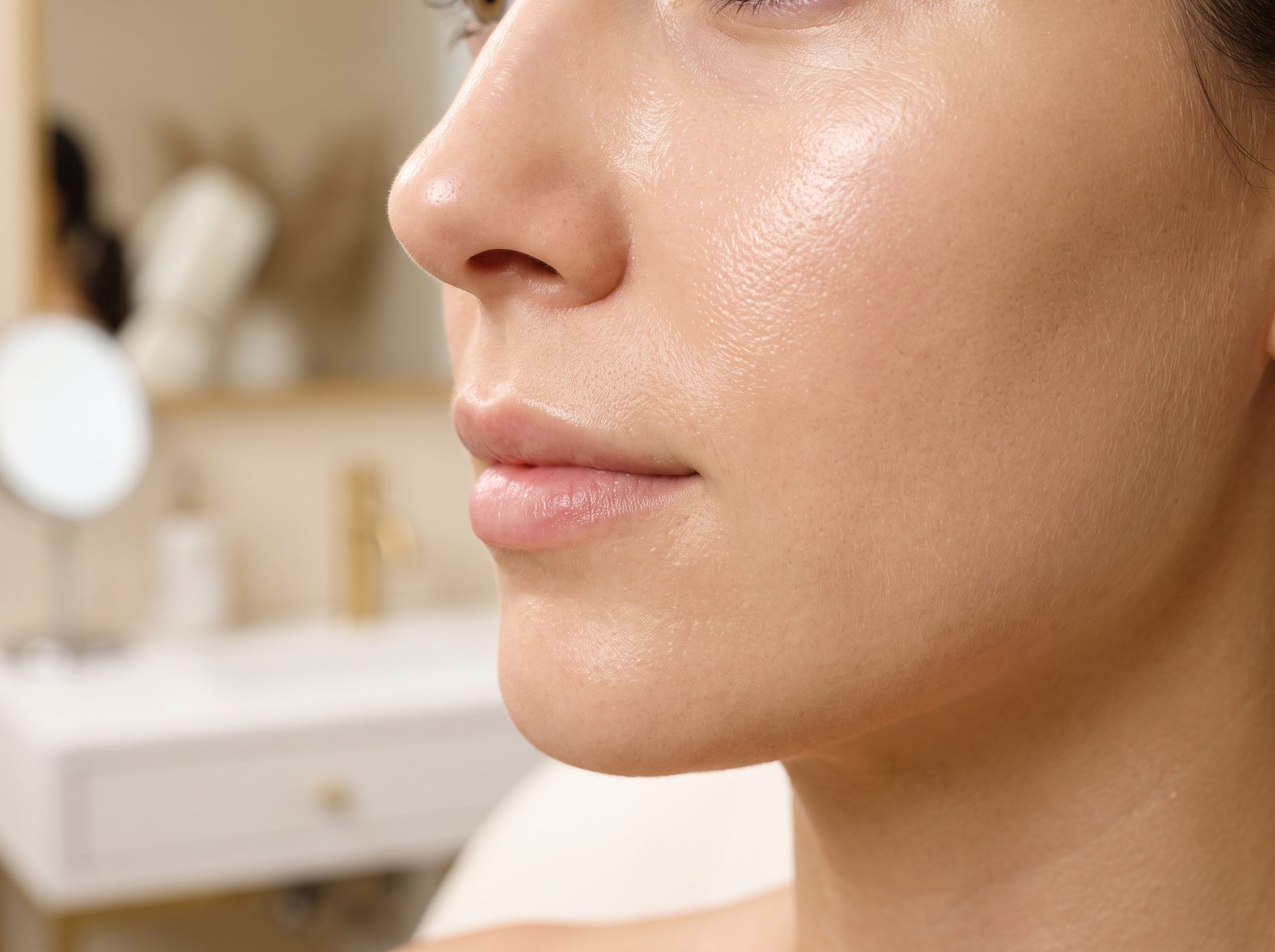
Microtox (Baby Botox): Smaller Pores, Less Shine, Skin That Still Moves
TREATMENTS
Microtox (Baby Botox): Smaller Pores, Less Shine, Skin That Still Moves
If you love what Botox does for wrinkles but you’re worried about looking “frozen,” Microtox is probably the treatment you’ve been waiting for. Also called micro-Botox, baby Botox, or mesobotox, it uses the same neurotoxin you already know, just delivered in a completely different way. Instead of relaxing big expression muscles, it’s micro-dosed into the surface of the skin to refine pores, calm oil and shine, and soften fine lines while keeping your expressions completely natural. Here’s the plain-language breakdown, backed by the research.
What Microtox actually is
Microtox is botulinum toxin type A, the same active ingredient in Botox, Dysport, and Xeomin, but diluted and injected very superficially as tiny droplets just under the skin’s surface (intradermally), rather than deep into a muscle.¹ Because the dose at each point is so small and so shallow, it works on the skin and the tiny structures in it rather than freezing the muscles that move your face. The technique is sometimes described in the literature as “microbotox” or “microdroplet” botulinum toxin.² ³
How it works
Your skin’s surface contains tiny oil (sebaceous) glands, sweat glands, and the small muscle fibers that pull pores open. Micro-dosed toxin placed at this shallow level appears to turn down oil production and tighten the look of pores while leaving the large expression muscles untouched.¹ ⁴ That’s the whole point of the technique: you get smoother, less shiny, more refined skin, but you can still raise your brows, smile, and make every normal expression. No frozen look.
What the science says
The evidence for intradermal (micro-dose) botulinum toxin has grown substantially:
- A 2024 systematic review and meta-analysis in Plastic and Reconstructive Surgery, Global Open evaluated intradermal botulinum toxin A and found it improves skin quality and facial rejuvenation measures.¹
- A dedicated review of the microbotox / microdroplet technique summarized its use for refining skin texture, reducing oiliness, and improving fine lines and laxity.² ³
- An expert roundtable in Aesthetic Surgery Journal focused specifically on using intradermal botulinum toxin microdoses to improve pore size, skin laxity, sebum (oil) control, and scars, and how to integrate it into practice.⁴
- The technique was popularized by a published clinical method for the lower face and neck showing real-world improvement in skin smoothness and jawline definition.⁵
- On the mechanism side, a review in Toxins details how botulinum toxin type A can influence facial oiliness (seborrhea), helping explain the reduced-shine effect patients notice.⁶
Where we use it
Microtox is ideal when your concern is skin quality, not deep wrinkles:
- Enlarged or visible pores across the cheeks, nose, and forehead.
- Oily, shiny skin and the midday “T-zone” shine that powder never fixes for long.
- Fine surface lines that don’t need full muscle relaxation.
- The lower face and neck, where it can subtly smooth and refine without heaviness.⁵
- It also pairs beautifully with traditional Botox in the upper face, full-strength where you want wrinkle control, micro-dose where you want glass-skin refinement.
Is it safe? How long does it last?
Microtox uses the same well-established toxin that has decades of safety data behind it, simply at lower, more superficial doses.¹ Because the dosing is gentle and surface-level, the “frozen” risk is minimal, that’s the entire design of the technique. Results typically build over about a week and last on the order of a few months, similar in spirit to regular neurotoxin, after which a maintenance session keeps the refinement going. As with any injection, brief redness or tiny bumps at the surface can occur and settle quickly.
It’s not one-size-fits-all
How superficial to go, how diluted, how many micro-points, and which zones to treat all depend on your skin type, your oiliness, your pore pattern, and your goals. Microtox is a finesse treatment, the technique matters more than the product. It’s also not a substitute for traditional Botox when you have strong, deep expression lines. This is a clinical judgment call. At Lumini, we start with a consultation: our medical team looks at your skin under good lighting and designs the right approach, sometimes Microtox alone, sometimes alongside classic neurotoxin.
At Lumini Medical Spa (Aventura Mall)
We offer Microtox for refined pores, oil and shine control, and a natural, never-frozen finish, on its own or combined with traditional Botox, Dysport, or Xeomin. Pricing is personalized at your consultation, because your plan depends on your skin and the zones you want treated. Our team treats patients in English, Spanish, and Portuguese, and we serve Aventura, Sunny Isles, Bal Harbour, and North Miami Beach.
Frequently asked questions
Will Microtox freeze my face like regular Botox? No, that’s the point. Microtox is micro-dosed into the surface of the skin rather than deep into expression muscles, so it refines skin while keeping your movement natural.¹ ⁴
What does Microtox actually do for my skin? It helps reduce oil and shine and tighten the look of pores, and it softens fine surface lines, improving overall skin quality.¹ ⁴ ⁶
Is “baby Botox” the same as Microtox? They overlap. “Baby Botox,” “micro-Botox,” “microbotox,” and “mesobotox” all describe lower-dose, more superficial neurotoxin used for a natural, skin-refining result.² ³
How long does Microtox last? Results build over about a week and generally last a few months, after which a maintenance treatment keeps the refinement going.
Can I combine Microtox with regular Botox? Yes, many patients do full-strength toxin in the upper face for wrinkle control plus Microtox elsewhere for pore and shine refinement. Your plan is set at consultation.
References
- Rahman E, et al. Intradermal Botulinum Toxin A on Skin Quality and Facial Rejuvenation: A Systematic Review and Meta-analysis. Plast Reconstr Surg Glob Open. 2024. PMID: 39185380. https://pubmed.ncbi.nlm.nih.gov/39185380/
- Kandhari R, et al. Microdroplet Botulinum Toxin: A Review. J Cutan Aesthet Surg. 2022. PMID: 35965899. https://pubmed.ncbi.nlm.nih.gov/35965899/
- Iranmanesh B, et al. Employing microbotox technique for facial rejuvenation and face-lift. J Cosmet Dermatol. 2022. PMID: 35064633. https://pubmed.ncbi.nlm.nih.gov/35064633/
- Fabi SG, et al. Microtoxin for Improving Pore Size, Skin Laxity, Sebum Control, and Scars: A Roundtable on Integrating Intradermal Botulinum Toxin Type A Microdoses Into Clinical Practice. Aesthet Surg J. 2023. PMID: 36857534. https://pubmed.ncbi.nlm.nih.gov/36857534/
- Wu WTL. Microbotox of the Lower Face and Neck: Evolution of a Personal Technique and Its Clinical Effects. Plast Reconstr Surg. 2015. PMID: 26441119. https://pubmed.ncbi.nlm.nih.gov/26441119/
- Rho NK, et al. Botulinum Neurotoxin Type A in the Treatment of Facial Seborrhea and Acne: Evidence and a Proposed Mechanism. Toxins. 2021. PMID: 34822601. https://pubmed.ncbi.nlm.nih.gov/34822601/
Medically reviewed by Dr. Thiago Queiroz, D.O., Medical Director, Lumini Medical Spa. Educational, not a substitute for an in-person consultation.