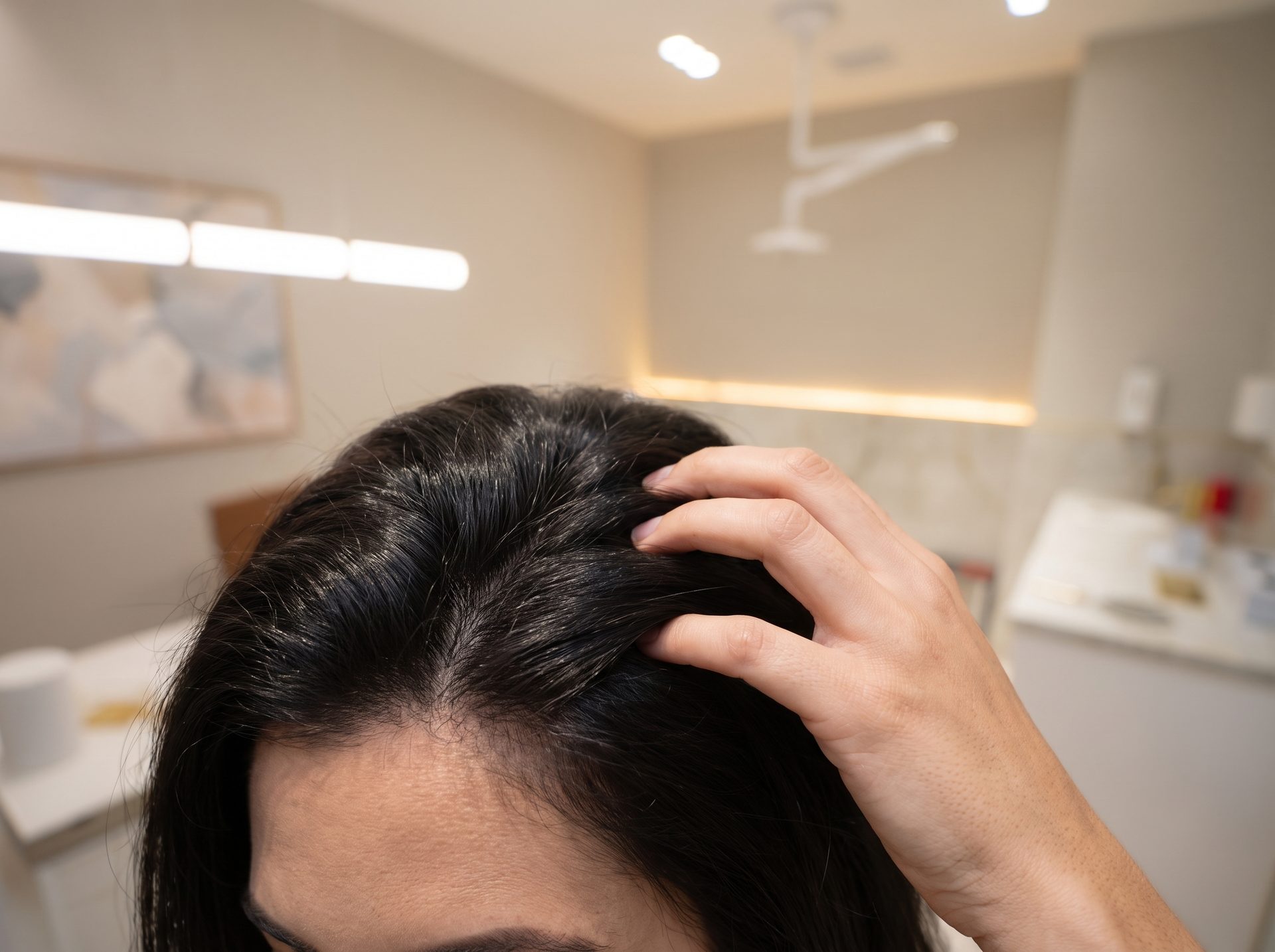
Hair Loss Treatment in Aventura: What Works and Where PRP Fits
TREATMENTS
Hair Loss Treatment in Aventura: What Works and Where PRP Fits
The best hair loss treatment depends on why the hair is thinning. Pattern hair loss, sudden shedding after illness, patchy autoimmune loss, traction, nutritional deficiency and scarring conditions can look similar at first but need different care. Starting a procedure before identifying the pattern can waste time and, in some conditions, delay treatment that protects the remaining follicles.
This guide explains the main causes, the treatments with the strongest established role, what current evidence says about platelet-rich plasma (PRP) and platelet-rich fibrin (PRF), and how Lumini may combine Fotona HairLase, Exceed microneedling, Lavieen fractional thulium laser, MesojectGun and Toskani scalp solutions in a personalized plan.
First: hair loss is a symptom, not one diagnosis
The American Academy of Dermatology emphasizes that finding the cause is the key to treating hair loss. The history, pattern, scalp examination and, when indicated, laboratory testing or a biopsy help distinguish common shedding from inflammatory or scarring disease.¹ ²
| Pattern | What it can suggest | Why it matters |
|---|---|---|
| Gradual widening part or crown thinning | Female or male pattern hair loss | Earlier treatment generally preserves more active follicles |
| Diffuse shedding after illness, surgery, childbirth or major stress | Telogen effluvium | The trigger and timeline guide management; many cases recover |
| Smooth round patches | Alopecia areata or another focal condition | Requires medical diagnosis; it is not ordinary pattern thinning |
| Pain, burning, scale, pustules or a shiny scar-like scalp | Inflammatory, infectious or scarring alopecia | Prompt medical evaluation may be needed to prevent permanent loss |
| Breakage or recession where styles pull tightly | Hair-shaft damage or traction alopecia | Removing the ongoing mechanical cause is essential |
Book a prompt in-person medical evaluation at Lumini for sudden or patchy loss, scalp pain or inflammation, eyebrow or eyelash loss, signs of scarring, a child with hair loss, or shedding accompanied by systemic symptoms. The consultation determines whether the pattern fits Lumini hair-restoration care or needs additional diagnostic workup before treatment.
Hair thinning in women: why the workup matters
Women often first notice a widening part, a smaller ponytail or more visible scalp under bright light. Female pattern hair loss is common, but diffuse shedding can also follow childbirth, fever, surgery, rapid weight change or major stress. Thyroid disease, iron or other nutritional deficiencies, hormonal disorders, medications, traction and inflammatory scalp disease may also contribute.²
That is why “hair thinning treatment for women” should not begin with the same package for everyone. A qualified clinician may review the timing, family history, menstrual or hormonal changes, nutrition, medications and scalp findings before recommending medical treatment, a procedure or additional diagnostic workup.
Which hair loss treatments actually work?
There is no universal winner. The strongest plan treats the cause and sets realistic expectations about timing and maintenance.
- Topical minoxidil: an over-the-counter, FDA-labeled option for pattern hair loss in appropriate men and women. It requires consistent use, takes months to assess and does not treat every cause of shedding.³
- Prescription treatment: finasteride 1 mg is FDA-approved for male pattern hair loss in men. Other oral or topical prescriptions may be used by a diagnosing clinician according to the patient’s sex, diagnosis, pregnancy potential, health history and risk profile.⁴
- Cause-specific care: correcting a documented deficiency, treating thyroid or inflammatory disease, addressing an infection, changing a damaging hairstyle or allowing recovery after a temporary trigger may be more important than adding a growth procedure.
- Hair transplantation: can redistribute follicles in appropriate candidates with stable donor hair. It is a surgical option and does not stop the biology affecting untreated follicles.
- Procedural adjuncts: PRP and selected energy- or injection-based treatments may support density in suitable patients, particularly while follicles are still active. They are not substitutes for diagnosing the cause.
Where PRP fits and where it does not
PRP is prepared from a small sample of the patient’s own blood. After centrifugation concentrates the platelet-rich fraction, the plasma is injected across selected thinning areas of the scalp. Platelets release signaling proteins involved in tissue repair; the clinical goal is to support miniaturizing, still-active follicles rather than create new follicles where they no longer exist.
Recent systematic reviews and meta-analyses of controlled studies report that PRP can improve hair density in androgenetic alopecia. They also identify meaningful limitations: small trials, different preparation methods, variable injection schedules and inconsistent follow-up. A 2024 meta-analysis of randomized trials found a positive effect on density, while emphasizing protocol variability; another 2024 meta-analysis found added benefit when PRP was combined with topical minoxidil.⁵ ⁶
The claim-safe conclusion is that PRP is a reasonable adjunct for selected patients with active follicles, not that it works for every type or stage of hair loss. Smooth long-standing bald areas, active infection, inflammatory or scarring alopecia, an untreated systemic cause and unrealistic expectations all change the decision.
Fotona HairLase: a laser designed to support scalp hair growth
Fotona’s hair-growth protocol, marketed by the manufacturer as HAIRestart and offered by Lumini as Fotona HairLase, uses the 2,940 nm Er:YAG wavelength in non-ablative SMOOTH mode. A rapid sequence of low-fluence pulses creates controlled, gentle heating without materially ablating the epidermis. The proposed effect is regenerative signaling around still-active follicles, including local growth-factor activity and changes in the hair cycle.⁷
This is not the same technology or goal as laser hair removal. HairLase uses non-ablative Er:YAG SMOOTH pulses to support scalp hair growth; laser hair removal uses a follicle-targeting protocol to reduce unwanted hair.
Several clinical publications support the concept, although the evidence base is still developing. A 2022 clinical series treated 16 women and men with androgenetic alopecia using non-ablative Er:YAG SMOOTH mode alone or alongside PRP, minoxidil or supplements. Blinded photographic assessment rated hair quality as improved in 93% of participants, with no adverse reactions reported; because treatments were mixed and the sample was small, the study cannot isolate the laser’s effect.⁸
A 2025 clinical observation followed 32 patients who received six non-ablative Er:YAG SMOOTH sessions and reported improvement in blinded global photographs and high satisfaction. The authors themselves noted that randomized controlled trials with objective measurements are still needed.⁹ A 2025 systematic review pooled 12 erbium-laser studies with 344 participants and found a growing body of supportive evidence, while also reflecting differences in laser type, protocol and study design.¹⁰
Can HairLase be combined with PRP?
Yes. Lumini may associate HairLase with PRP when the pattern, follicle activity and treatment goals support a combined plan. The two procedures act through different proposed pathways: PRP delivers an autologous concentration of platelet signaling factors, while HairLase produces controlled non-ablative thermal stimulation of the scalp.
Published evidence includes the mixed-treatment 16-patient series above and a case report in which one man with androgenetic alopecia showed increased density after three combined Er:YAG SMOOTH + PRP sessions, with the result maintained for several months.¹¹ These findings support clinical interest in the combination, but a case report and an uncontrolled mixed-treatment series do not prove that the combination is superior for every patient. The decision and sequence should remain individualized.
PRP versus PRF: related, but not interchangeable
PRP and PRF are both autologous preparations made from the patient’s blood, but their centrifugation, platelet and leukocyte composition, fibrin structure and handling differ. PRP has the larger hair-loss evidence base. Injectable PRF is promising, but the published literature is smaller: a 2024 case series of 11 women reported improvement after three monthly i-PRF sessions, while a 2024 systematic review found only three alopecia studies and called for larger controlled trials and standardized protocols.¹² ¹³
At Lumini, the consultation identifies the actual preparation, delivery route and sequence rather than treating “PRP” and “PRF” as interchangeable labels. Direct intradermal placement of an autologous concentrate is also different from applying a compatible product after a channel-forming procedure.
How Lumini can build a hair-restoration protocol
Lumini has several ways to stimulate the scalp or deliver a selected adjunct. They are not duplicates: each creates a different tissue interaction, has different evidence and may fit a different patient.
| Option | How it works | Where it may fit |
|---|---|---|
| PRP or PRF | An autologous platelet concentrate prepared from the patient’s blood and placed according to the selected medical protocol | A biologic adjunct for selected patients with active follicles; PRP has stronger evidence than PRF |
| Fotona HairLase | Non-ablative 2,940 nm Er:YAG SMOOTH pulses create controlled thermal stimulation without needles | A stand-alone or combination option when the scalp pattern and follicle activity support it |
| Exceed microneedling | Sterile needles create controlled microchannels in the scalp | May be incorporated into a clinician-selected scalp protocol; microneedling evidence is encouraging but heterogeneous¹⁴ |
| Lavieen 1927 nm thulium laser | Fractional thulium energy creates microscopic treatment zones that can support laser-assisted topical delivery | An off-label hair protocol supported by small studies of 1927 nm fractional thulium, with or without post-laser growth-factor solutions¹⁹ ²⁰ |
| MesojectGun + Toskani | Needle-free Pulse Booster® electroporation and superficial microabrasion enhance transdermal delivery of a compatible professional scalp solution | A lower-downtime route for selected Toskani protocols, including HCPR or Hair Cocktail Plus¹⁶ ¹⁷ ¹⁸ |
Exceed microneedling: microchannels, with a regulatory distinction
A systematic review of 22 hair-loss studies found generally favorable results when microneedling was used as an adjunct, including combinations with minoxidil, growth-factor solutions or topical PRP, but it also found low-quality, heterogeneous evidence and no standardized best protocol.¹⁴ The Exceed device itself is FDA-cleared for specified facial indications, not for hair loss. Its FDA classification also does not include transdermal delivery of cosmetics, drugs or biologics.¹⁵ A scalp or combination protocol is therefore a clinician-directed off-label use and should not be described as FDA-cleared PRP or PRF delivery.
MesojectGun with Toskani HCPR or Hair Cocktail Plus
Toskani describes MesojectGun as a needle-free transdermal delivery platform that combines controlled electrical pulses with superficial microabrasion and includes hair and scalp-revitalization protocols.¹⁶ It is the clearest delivery match for compatible Toskani professional-use solutions. HCPR is a peptide-based complex with vitamins, amino acids, nucleic acids and biomimetic peptides such as copper tripeptide-1; Hair Cocktail Plus is the second component in Toskani’s professional anti-hair-loss kit.¹⁷ ¹⁸ These branded formulations have manufacturer support, but they do not have the same independent clinical evidence base as minoxidil or PRP.
Lavieen: fractional thulium channels and laser-assisted delivery
Lavieen uses a 1,927 nm thulium laser. Its FDA-cleared indications are dermatologic coagulation, actinic keratosis and benign pigmented lesions, not hair loss.¹⁹ However, a blinded split-scalp study in 10 patients found improved density and thickness after 12 fractional 1,927 nm sessions, with additional improvement where a growth-factor solution was applied after treatment.²⁰ This supports a biologically plausible channel-assisted strategy, but the study was small and does not establish that every PRP, PRF or peptide product is suitable for laser-assisted delivery.
These services can be sequenced or combined only when the evaluation supports it. The right plan may use one modality, a staged combination, an established medical treatment, or additional diagnostic evaluation before any cosmetic procedure.
What to expect from a hair-loss consultation
A useful consultation should document when the change began, whether loss is shedding, breakage or patterned thinning, family history, recent illness or surgery, childbirth, rapid weight change, medications, nutrition, styling practices and scalp symptoms. The scalp and density pattern should be examined before a procedural plan is proposed.
If the pattern is compatible with cosmetic hair restoration and no red flag requires additional diagnostic workup before treatment, the discussion can cover which follicles may still respond; whether PRP, PRF, HairLase, Exceed, Lavieen or MesojectGun with a Toskani scalp solution has a rational role; expected discomfort and downtime; the likely treatment series; maintenance; and how progress will be documented. Hair changes occur over growth cycles, so credible assessment is measured in months, not days.
Lumini is inside Aventura Mall and serves Aventura, Sunny Isles Beach, Bal Harbour, North Miami Beach and greater Miami. Care is physician-supervised and available in English, Spanish and Portuguese.
Frequently asked questions
What causes hair thinning in women? Common possibilities include female pattern hair loss, temporary shedding after illness, childbirth or stress, thyroid or nutritional problems, hormonal disorders, medications, traction and inflammatory scalp disease. The pattern and history determine which evaluation is appropriate.
Does PRP work for hair loss? Meta-analyses suggest PRP can improve hair density in selected patients with androgenetic alopecia, but study protocols and results vary. It is an adjunct, not a cure or a treatment for every cause.
How many PRP hair sessions are needed? There is no universal schedule. Published protocols vary, and Lumini individualizes the initial series and maintenance after evaluating the pattern, stage and response.
Can Fotona HairLase be combined with PRP? Yes. Lumini may combine them in selected patients because HairLase provides non-ablative thermal stimulation while PRP supplies autologous platelet signaling factors. Published reports are encouraging, but the combination is not proven superior for every patient.
Can Exceed, Lavieen or MesojectGun be used with PRP, PRF or peptide solutions? They can be considered within different clinician-selected protocols, but they do not deliver products in the same way. Exceed mechanically creates microchannels, Lavieen creates fractional laser treatment zones, and MesojectGun uses needle-free electroporation plus superficial microabrasion for compatible professional solutions. Product labeling, sterility and molecular size determine the appropriate route; none should be described as universally interchangeable or FDA-cleared for hair-loss drug delivery.
Is PRP appropriate for all hair loss? No. Patchy, sudden, inflammatory, infectious or scarring loss may require additional diagnostic evaluation and cause-specific treatment. PRP also cannot recreate follicles that are no longer active.
When does hair loss need prompt medical evaluation? Book a prompt in-person medical evaluation at Lumini for sudden or patchy loss, scalp pain, burning, scale or pustules, visible scarring, eyebrow or eyelash loss, systemic symptoms, or uncertainty about the diagnosis. The consultation determines the appropriate next step.
Is hair restoration the same as laser hair removal? No. Hair restoration aims to support scalp hair growth. Laser hair removal targets unwanted body or facial hair follicles to reduce growth. Lumini uses different technologies and protocols for those opposite goals.
Where can I get hair loss treatment near Aventura? Lumini Medical Spa offers consultations for PRP/PRF hair restoration, Fotona HairLase, Exceed microneedling, Lavieen fractional thulium and MesojectGun protocols with Toskani HCPR or Hair Cocktail Plus inside Aventura Mall, Suite 1954. Lumini begins with an in-person consultation and guides the appropriate next step when the pattern needs additional diagnostic workup.
References
- American Academy of Dermatology. Hair loss: Treatment. aad.org.
- American Academy of Dermatology. Hair loss: Who gets and causes. aad.org.
- U.S. National Library of Medicine. Minoxidil topical drug label. DailyMed. dailymed.nlm.nih.gov.
- U.S. Food and Drug Administration. PROPECIA (finasteride) tablets, prescribing information. NDA 020788. FDA label.
- Kieling L, et al. Is autologous platelet-rich plasma capable of increasing hair density in patients with androgenic alopecia? A systematic review and meta-analysis of randomized clinical trials. An Bras Dermatol. 2024;99(6):847-862. PMID: 39013743. PubMed.
- Yao J, et al. The additive value of platelet-rich plasma to topical Minoxidil in the treatment of androgenetic alopecia: A systematic review and meta-analysis. PLoS One. 2024;19(8):e0308986. PMID: 39197003. PubMed.
- Fotona. HAIRestart: Non-Invasive Laser Stimulation of Hair Growth. Official treatment information. fotona.com.
- Day D, McCarthy M, Talaber I. Non-ablative Er:YAG laser is an effective tool in the treatment arsenal of androgenetic alopecia. J Cosmet Dermatol. 2022;21(5):2056-2063. PMID: 34435735. PubMed.
- Zhang Y, et al. Nonablative Er:YAG Laser Treatment of Androgenetic Alopecia: A Clinical Observation. Dermatol Ther. 2025. doi:10.1155/dth/2419414. Journal.
- Nilforoushzadeh MA, et al. A systematic review of erbium lasers in the treatment of androgenetic alopecia. Lasers Med Sci. 2025. PMID: 40402190. PubMed.
- Maksimov DV. Experience in Treatment of Androgenetic Alopecia using Er:YAG Laser (SMOOTH Mode) Combined with Platelet-rich Plasma. J Laser Health Acad. 2021. LA&HA.
- Sharma S, et al. Injectable platelet-rich fibrin for treatment of female pattern hair loss. J Cosmet Laser Ther. 2024;26(1-4):17-25. PMID: 38989555. PubMed.
- Mohale SA, et al. Effectiveness of Injectable Platelet-Rich Fibrin Therapy in Alopecia and Facial Rejuvenation: A Systematic Review. Cureus. 2024;16(6):e62198. PMID: 39011192. PubMed.
- English RS Jr, et al. Microneedling and Its Use in Hair Loss Disorders: A Systematic Review. Dermatol Ther (Heidelb). 2022;12(1):41-60. PMID: 34854067. PubMed.
- U.S. Food and Drug Administration. Exceed Microneedling Device 510(k) K180778. FDA clearance.
- Toskani. TKN MesojectGun: The intelligent evolution of transdermal delivery. Official device information. toskani.com.
- Toskani. HCPR professional scalp solution. Official product information. toskani.com.
- Toskani. Starter Kit Anti Hair Loss: Hair Cocktail Plus and HCPR. Official product information. toskani.com.
- U.S. Food and Drug Administration. Lavieen 1927 nm thulium laser 510(k) K241406. FDA clearance.
- Cho SB, et al. Therapeutic efficacy and safety of a 1927-nm fractionated thulium laser on pattern hair loss: an evaluator-blinded, split-scalp study. Lasers Med Sci. 2018;33(4):851-859. PMID: 29340854. PubMed.
Medically reviewed by Dr. Thiago Queiroz, D.O., Medical Director, Lumini Medical Spa. Educational, not a substitute for an in-person consultation.