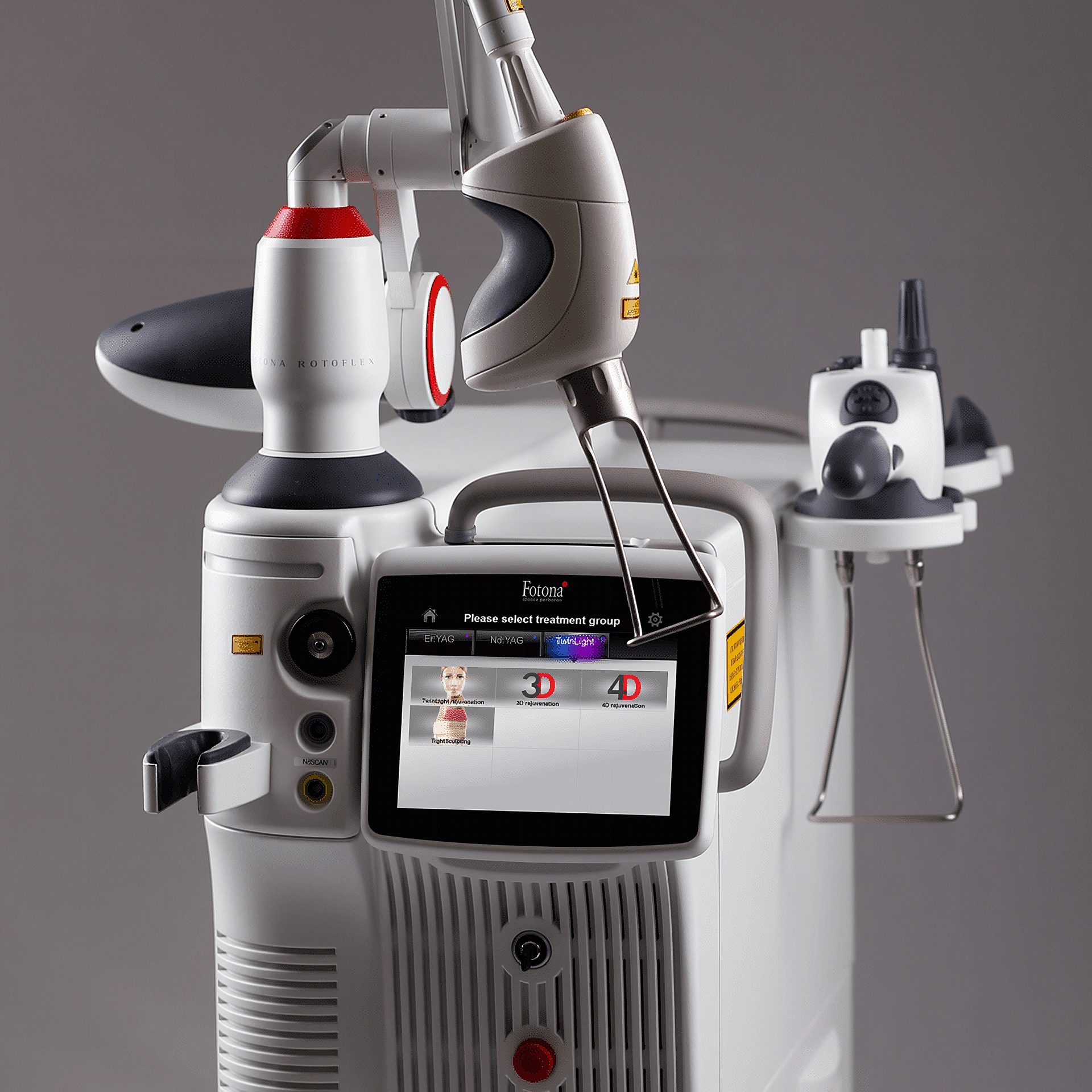
Fotona 4D Laser Facelift: How the 4 Steps Work, Results, Sessions and Downtime
TREATMENTS
Fotona 4D Laser Facelift: How the 4 Steps Work, Results, Sessions and Downtime
Fotona 4D is a non-surgical, no-needle laser protocol that combines two wavelengths, Er:YAG and Nd:YAG, in four sequential steps during one session, including one step performed from inside the mouth. The aim is gradual tightening, a subtle lift and smoother, brighter skin, with little downtime. It is often called a “laser facelift”, but it is not a surgical facelift and does not replace one when sagging is advanced. Some patients notice mild tightening right away, and any further firming develops gradually over the following months, usually across a series of sessions; how much changes varies from person to person. At Lumini Medical Spa, located inside Aventura Mall, the four steps are tailored to each face after an in-person assessment. This guide explains what each step does, what results and timelines are realistic, how many sessions are typical, who is a good candidate and what the research supports.
What Fotona 4D Is
Fotona 4D is a treatment protocol developed for the Fotona laser platform. Rather than a single pass, it layers four modes that act at different depths:
- An Er:YAG laser (erbium, 2940 nm), strongly absorbed by water, which works on the surface and shallow layers of the skin and, in a non-ablative mode, on the inner lining of the mouth.
- An Nd:YAG laser (neodymium, 1064 nm), which penetrates deeper to heat the dermis and the tissue below it and stimulate collagen.
The “4D” refers to treating the face in several dimensions: from inside the mouth, through the deeper tissue, and at the surface. Heating collagen does two things. It contracts existing collagen fibers, which gives some immediate tightening, and it triggers new collagen formation over the following weeks, which gives the gradual firming that patients notice later.
The individual wavelengths behind the protocol are well studied. A randomized study comparing long-pulse Nd:YAG with fractional Er:YAG found that both improved facial wrinkles, and sequential resurfacing that pairs a variable-pulse Er:YAG with a scanner-assisted Nd:YAG has been described as a surface-plus-depth strategy for fractional resurfacing and remodeling.
Step 1: SmoothLiftin, Lifting From Inside the Mouth
SmoothLiftin is the signature step. The provider places a specially designed handpiece inside the mouth and delivers non-ablative Er:YAG energy to the inner lining of the cheeks and the area behind the nasolabial folds and lips. The mucosa is heated without being broken, which stimulates collagen in the tissue from behind, where folds form, without touching the outer skin surface.
This step has its own supporting evidence. A prospective, randomized, split-face pilot study used optical coherence tomography to evaluate intraoral non-ablative Er:YAG in SMOOTH mode for nasolabial folds and found measurable improvement. A separate study also reported correction of nasolabial fold wrinkles with intraoral non-ablative Er:YAG. Patients usually describe the sensation as warmth, and there is no visible mark on the face afterward.
Step 2: FRAC3, Deep Fractional Remodeling
FRAC3 uses the Nd:YAG laser in very short pulses, delivered in a fractional, three-dimensional pattern. The energy concentrates on small structural imperfections inside the skin, such as fine texture irregularities, redness and some pigment, while the surrounding tissue is spared. The result is collagen stimulation beneath the surface and a more even, refined skin tone over the following weeks.
Because FRAC3 works below the surface, it is gentle on the outer skin, but settings still need to match skin type. Deeper skin tones and pigment-prone skin require a conservative approach to limit the risk of pigment changes.
Step 3: PIANO, Bulk Heating for Tightening
PIANO is the deep-heating step. The Nd:YAG laser delivers long, low-intensity pulses that warm large volumes of tissue, reaching the deeper dermis and the layer beneath it, evenly and gradually. Patients feel a comfortable, spreading warmth. The goal is collagen contraction and remodeling across the whole treated area, which is intended to provide much of the protocol’s tightening effect.
This step is also why Fotona 4D is often applied beyond the face. Lumini offers the protocol for the face, the face and neck, or the neck alone, where laxity and fine lines often show early.
Step 4: SupErficial, Surface Resurfacing
The final step uses the Er:YAG laser as a very light resurfacing pass, sometimes described as a laser peel. It removes a microscopically thin layer of the outermost skin, refining texture, softening fine lines and adding glow. Er:YAG resurfacing is well established in facial rejuvenation because the wavelength is absorbed so strongly by water that heat spreads very little into the surrounding skin.
The depth of this step can be adjusted. A lighter pass means almost no visible downtime; a slightly deeper pass may cause a few days of fine flaking or a sandpaper feel, in exchange for a more noticeable surface refresh.
Results Timeline and Number of Sessions
Fotona 4D results build rather than appear all at once:
- Right after the session, the skin often looks slightly flushed, and some patients notice a mild tightening.
- Over the first weeks, surface texture and brightness improve as the skin renews.
- Over the following months, collagen remodeling may bring gradual firming. Studies of individual laser steps assessed results at follow-up visits up to six months after treatment, and the amount of change varies.
At Lumini, a typical plan is a series of about three to four sessions, spaced a few weeks apart, followed by periodic maintenance as natural aging continues. This is our usual starting point, not a number established by clinical trials: no large trial has tested the full four-step protocol, and the published studies of its individual steps used different schedules, such as five monthly or six fortnightly intraoral sessions. The exact number depends on your skin, the degree of laxity and your goals, and is set at consultation. A session for the face typically takes about 30 to 60 minutes.
Results are subtle to moderate by design. Fotona 4D aims to soften nasolabial folds, tighten mild laxity and improve skin quality. The intraoral step has the most direct study support, for nasolabial folds; any change in jawline definition is usually slight and has not been measured for the full protocol. It cannot lift significant sagging the way surgery does. Results vary from person to person.
Who Fotona 4D Suits, and How It Compares
Fotona 4D tends to suit people who:
- Have early to moderate skin laxity and want a refresh rather than a dramatic change.
- Want to soften nasolabial folds and the area around the mouth without filler.
- Prefer a no-needle option with little or no social downtime.
- Want to improve skin texture and tone at the same time as tightening.
It is often combined with other treatments. Where volume loss is part of the picture, a biostimulator or filler addresses what heat cannot. Where laxity is deeper, radiofrequency options can be considered. Morpheus8 vs. Fotona 4D compares the two approaches, and Building Your Treatment Plan explains how treatments are sequenced. Laser protocols are also used around the eyes: a published protocol used Fotona laser treatment for eyebrow elevation, an alternative some patients consider alongside or instead of threads.
Fotona 4D may not be appropriate during pregnancy, with active skin infection or inflammation in the area, with recent sun tanning, or with certain medications and conditions that affect healing or light sensitivity. Your medical history is reviewed before treatment.
Safety, Downtime and What the Evidence Says
Fotona 4D is non-ablative to minimally ablative depending on the step, which is why downtime is usually minimal. Typical, temporary effects include:
- Redness and warmth for a few hours to a day.
- Mild swelling, especially after the intraoral step.
- Light flaking or a rough texture for a few days if the surface step is deeper.
Less common risks include pigment changes, particularly in deeper skin tones or recently tanned skin, blistering and, rarely, burns when settings are not matched to the skin. That is why settings are chosen for each skin type and adjusted between steps, and why sun protection matters before and after treatment. Contact the clinic promptly if you notice blistering, crusting, increasing pain or signs of infection.
The evidence for the protocol comes mainly from studies of its individual components rather than large trials of the full four-step sequence, so realistic expectations are part of good care.
Frequently Asked Questions
1. Is Fotona 4D a real facelift?
No. It is a non-surgical, no-needle laser treatment that tightens and lifts gradually by heating collagen. It will not replace surgery for advanced sagging, but it can deliver a visible refresh and subtle lift.
2. Why is part of the treatment done inside the mouth?
The SmoothLiftin step heats the tissue behind the nasolabial folds and around the mouth from the inside, stimulating collagen where folds form without affecting the outer skin surface.
3. Does Fotona 4D hurt, and is there downtime?
Most patients describe warmth rather than pain, and no anesthetic injection is needed. Downtime is usually limited to redness and mild swelling for a few hours to a day, with light flaking if the surface step is deeper.
4. When will I see results?
Some tightening can be noticeable right away. Any further firming builds gradually over the following months as collagen remodels, and how much varies from person to person. At Lumini, treatment is usually planned as a series of sessions.
5. How many Fotona 4D sessions do I need, and how long do results last?
At Lumini, plans typically start with about three to four sessions spaced a few weeks apart, followed by periodic maintenance. This reflects our usual practice rather than trial data on the full protocol. Results fade gradually with natural aging, so maintenance helps sustain them; your exact plan is set at consultation.
6. Can Fotona 4D be combined with Botox or filler?
Yes. It works on skin tightness and quality, while neuromodulators relax muscle-driven lines and fillers or biostimulators restore volume. Your provider will plan the order and spacing of treatments.
7. How much does Fotona 4D cost at Lumini Medical Spa?
Pricing is confirmed after consultation because it depends on the areas treated and the number of sessions in your plan. Consultations are complimentary with any same-day treatment; otherwise $200. See our pricing page for published prices.
References
- Dadkhahfar S, Fadakar K, Robati RM. Efficacy and safety of long pulse Nd:YAG laser versus fractional erbium:YAG laser in the treatment of facial skin wrinkles. Lasers in Medical Science. 2019;34(3):457-464. PMID: 30117052. https://pubmed.ncbi.nlm.nih.gov/30117052/
- Marini L. SPF-RR sequential photothermal fractional resurfacing and remodeling with the variable pulse Er:YAG laser and scanner-assisted Nd:YAG laser. Journal of Cosmetic and Laser Therapy. 2009;11(4):202-211. PMID: 19951189. https://pubmed.ncbi.nlm.nih.gov/19951189/
- Moftah N, Samy N, Allam RSHM, El Tagy SAH, et al. Optical coherence tomographic (OCT) evaluation of intraoral non-ablative erbium: YAG laser (SMOOTH mode) in rejuvenation of nasolabial folds; A prospective randomized split face comparative pilot study. Skin Research and Technology. 2020;26(3):405-412. PMID: 31794102. https://pubmed.ncbi.nlm.nih.gov/31794102/
- Ebrahim HM, Gharib K. Correction of nasolabial folds wrinkle using intraoral non-ablative Er:YAG laser. Journal of Cosmetic and Laser Therapy. 2018;20(6):364-368. PMID: 29482388. https://pubmed.ncbi.nlm.nih.gov/29482388/
- Caniglia RJ. Erbium:YAG laser skin resurfacing. Facial Plastic Surgery Clinics of North America. 2004;12(3):373-377. PMID: 15261174. https://pubmed.ncbi.nlm.nih.gov/15261174/
- Burmann TG, Duarte FB, Akaishi PMS. Fox eyes lift-A new protocol for eyebrow elevation with laser Fotona. Journal of Cosmetic Dermatology. 2024;23(2):450-456. PMID: 37986696. https://pubmed.ncbi.nlm.nih.gov/37986696/
For treatment details, see our Fotona 4D treatment page and the Fotona laser platform, or compare it with Morpheus8 vs. QuantumRF for deeper laxity. If you are ready to discuss your goals, book a consultation at Lumini Medical Spa in Aventura Mall.
Medically reviewed by Dr. Thiago Queiroz, D.O., Medical Director, Lumini Medical Spa. Educational, not a substitute for an in-person consultation.