Pigment on Skin of Color: How Newer Picosecond Lasers Lower the Risk of Making It Worse
SKINCARE
Pigment on Skin of Color: How Newer Picosecond Lasers Lower the Risk of Making It Worse
If you have a medium-to-deep skin tone and you’ve ever been told to be careful with lasers for your dark spots or melasma, that caution is well earned. The single biggest fear with pigment treatment in richer skin is post-inflammatory hyperpigmentation (PIH), the treatment leaves you darker, not clearer. The good news is that the technology has moved, and the way a laser is built now matters more than ever. Here’s the plain-language version of why the newest picosecond lasers are gentler on melanin-rich skin, backed by the actual research.
Why pigment treatment is riskier in skin of color
Melanin is protective, but it also absorbs laser energy. In darker skin there’s simply more of it, spread through the epidermis, so a laser aimed at a brown spot can also heat the surrounding skin and provoke the pigment cells into overproducing. That’s the mechanism behind PIH, and it’s why a treatment that works beautifully on fair skin can backfire on deeper tones. The answer isn’t to avoid treatment, it’s to use a device and settings that break up pigment with as little collateral heat as possible.
Speed is the safety feature: picoseconds vs nanoseconds
Older “Q-switched” lasers fire in nanoseconds (billionths of a second). Picosecond lasers fire roughly a thousand times faster, in trillionths of a second. That speed changes the mechanism: instead of heating pigment (a photothermal effect that spreads to nearby skin), an ultra-short pulse shatters it mechanically with a pressure wave, a photoacoustic effect, before the heat has time to travel.
This isn’t marketing; it shows up under the microscope. According to PubMed, a 2025 systematic review of laser-treated pigmented lesions found that picosecond lasers created smaller vacuoles with minimal surrounding damage, which the authors linked directly to the lower rates of post-inflammatory hyperpigmentation reported with picosecond versus nanosecond devices.¹ The same review noted that picosecond lasers confined tattoo particles neatly within cellular structures, while nanosecond lasers scattered them into surrounding tissue, a mechanistic reason the newer lasers tend to be both safer and more effective.¹
Newer and shorter is better
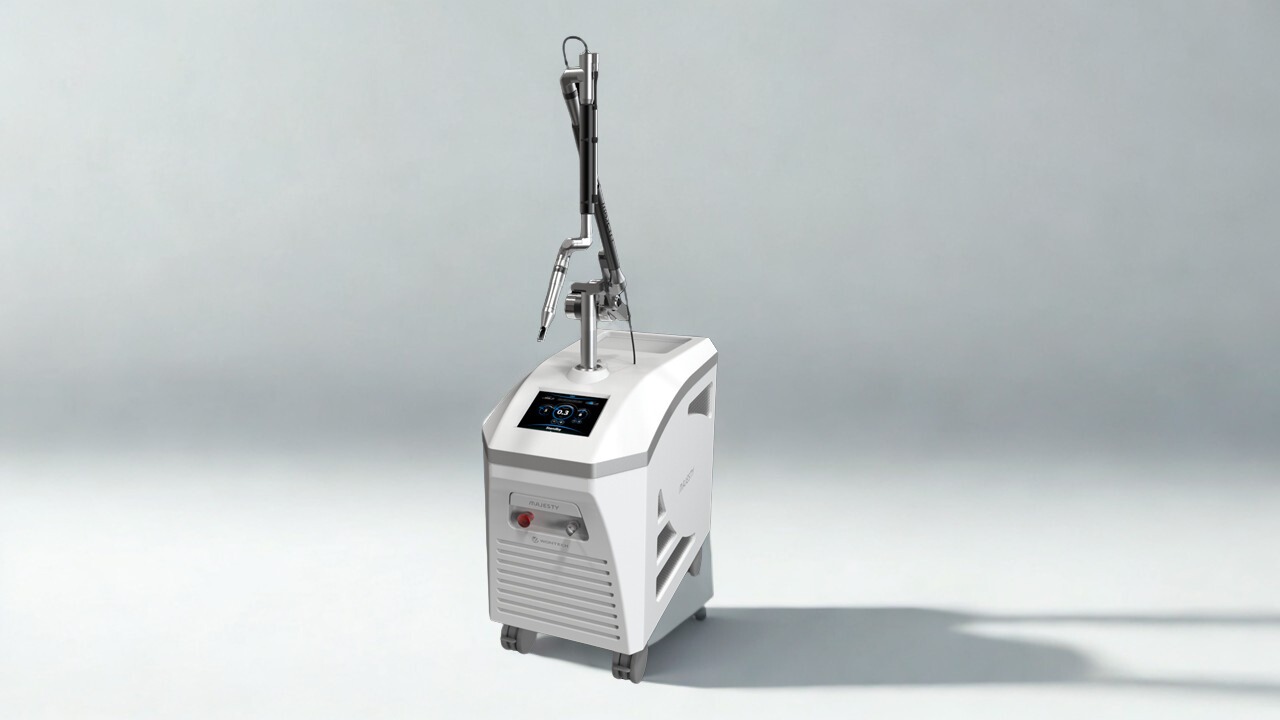
Not all picosecond lasers are the same. The first generation ran around 450 picoseconds; the newest generation, the platform we use at Lumini, PicoCare Majesty, runs at about 250 picoseconds, among the shortest pulse durations available. The principle is consistent: the shorter the pulse relative to the target’s own relaxation time, the more the effect stays photoacoustic and the less heat leaks into surrounding skin. For melanin-rich skin, that margin is exactly where PIH risk lives.
For pigment specifically, the 1064 nm wavelength penetrates deeper and is less absorbed by surface melanin, which is why it’s the wavelength of choice for darker skin tones, a principle long established across laser dermatology in skin of color. Our PicoCare laser page goes into the full range of wavelengths and handpieces we use.
Melasma is a special case, light management matters more than the laser
Melasma deserves its own paragraph because it’s the pigment problem that most often gets worse with aggressive treatment. It’s a chronic, light-driven condition, and even a well-chosen laser only holds if you control the light hitting your skin every day. According to PubMed, a 2022 review on melasma emphasized that it disproportionately affects darker-skinned individuals and that intensive broad-spectrum photoprotection can prevent flares, reduce severity, and cut relapses, while noting that dark-skinned patients often take fewer photoprotective measures.² In practice we treat melasma conservatively, at low energy, and always paired with strict sun protection; sometimes a gentler resurfacing tool like the Lavieen laser or a medical skincare routine is the better lead, with laser toning as a supporting player. Our full guide to melasma and dark spots walks through the options.
Why this matters in Aventura specifically
South Florida is one of the most diverse places in the country, and it’s also one of the sunniest. That combination, a large population with Fitzpatrick IV–VI skin, plus year-round intense UV and visible light, is exactly the setting where pigment problems are both common and easy to worsen with the wrong approach. This is why pigment work at Lumini is physician-led and consultation-driven: we match the device, the wavelength, and the energy to your skin type, not to a generic protocol.
At Lumini Medical Spa (Aventura Mall)
If you have deeper skin and you’ve been nervous about treating your dark spots or melasma, that instinct is right, and it’s exactly why the assessment matters. Our medical team evaluates your pigment and your skin type and builds a plan designed to clear pigment without provoking it. Pricing is personalized at your consultation. We treat patients in English, Spanish, and Portuguese, and we serve Aventura, Sunny Isles, Bal Harbour, and North Miami Beach.
Frequently asked questions
Is laser safe for dark or Black skin? Yes, with the right device and settings. The risk in deeper skin is post-inflammatory hyperpigmentation, which is minimized by using longer wavelengths (like 1064 nm), shorter pulse durations, and conservative energy. According to PubMed, picosecond lasers produce less surrounding tissue damage than older nanosecond lasers, which is linked to lower rates of post-treatment darkening.¹
Why do you say picosecond lasers cause less pigmentation? Because they shatter pigment with a fast pressure wave rather than heating it. Under the microscope, picosecond treatment leaves smaller zones of damage around the target, which correlates with fewer post-inflammatory pigment problems.¹
Can my melasma be cured with a laser? No treatment “cures” melasma, it’s a chronic, light-driven condition. Lasers can lighten it, but keeping it controlled depends far more on consistent daily photoprotection. Intensive broad-spectrum sunscreen use can prevent flares and reduce relapses.²
Why does 1064 nm keep coming up for darker skin? Longer wavelengths penetrate deeper and are less absorbed by the melanin at the skin’s surface, so they target the pigment you want while sparing the surrounding skin, the core reason 1064 nm is preferred for deeper skin tones.
Will I need more than one session? Usually. Pigment clears gradually as your immune system carries off the fragmented particles between sessions. The number depends on the type and depth of pigment, which we estimate at your consultation.
What should I do before and after to protect my results? Avoid tanning before treatment, and commit to daily broad-spectrum SPF afterward, for melasma-prone skin, a tinted mineral sunscreen adds visible-light protection. Consistent photoprotection is what keeps pigment from coming back.²
References
- Lee MS, Al Janahi S, Dover JS, Kelly KM, Chung HJ. Lasers and Energy-Based Devices for Treatment of Pigmented Lesions With Histologic and Ultrastructural Imaging Correlation: A Systematic Review. Dermatol Surg. 2025. PMID: 40767860. https://doi.org/10.1097/DSS.0000000000004803
- Morgado-Carrasco D, Piquero-Casals J, Granger C, Trullàs C, Passeron T. Melasma: The need for tailored photoprotection to improve clinical outcomes. Photodermatol Photoimmunol Photomed. 2022. PMID: 35229368. https://doi.org/10.1111/phpp.12783
Medically reviewed by Dr. Thiago Queiroz, D.O., Medical Director, Lumini Medical Spa. Educational, not a substitute for an in-person consultation. Research summaries via PubMed.