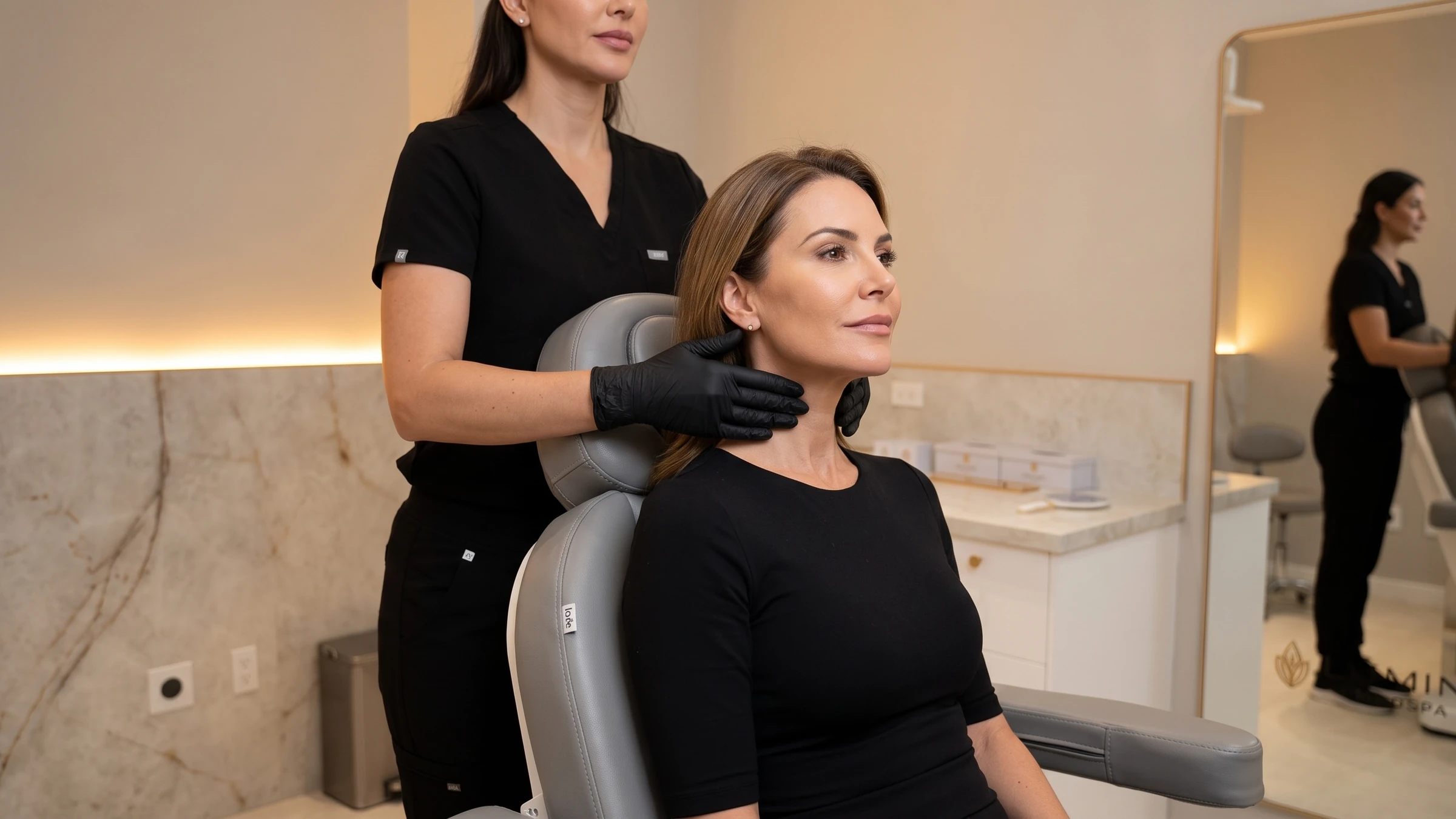
Nefertiti Lift: Botox for Neck Bands and Jawline Definition
What a Nefertiti lift may improve, what it cannot lift, and why neck anatomy requires individualized Botox planning.
Nefertiti Lift: Botox for Neck Bands and Jawline Definition
At Lumini Medical Spa, located within Aventura Mall, we approach aesthetic treatments with a commitment to anatomical precision and evidence-based practice. The term “Nefertiti lift” has gained significant traction in popular media as a descriptor for non-surgical jawline definition. However, it is crucial to distinguish between marketing terminology and the specific, FDA-approved clinical indications of the products used. This article clarifies the anatomy of the neck, the approved uses of botulinum toxin type A, and the realistic expectations patients should hold regarding this procedure.
Understanding Platysma Anatomy and Function
To understand how neuromodulators affect the lower face and neck, one must first appreciate the underlying muscular architecture. The platysma is a broad, thin sheet of muscle located in the subcutaneous tissue of the anterior neck. It originates from the fascia covering the upper parts of the pectoralis major and deltoid muscles and extends upward to insert into the lower border of the mandible (jawbone), the skin of the lower face, and the orbicularis oris muscle around the mouth.
The primary function of the platysma is to depress the mandible and tense the skin of the neck. When the muscle contracts, it creates vertical bands that run down the front of the neck. In many individuals, these bands become more prominent with age due to a combination of muscle hypertrophy (thickening), loss of skin elasticity, and gravitational descent of tissues. These visible cords are often referred to as “platysmal bands” or “neck bands.”
It is important to recognize that the platysma is not merely a superficial structure; it interacts dynamically with the deeper cervical fascia and surrounding musculature. Its tone contributes significantly to the contour of the jawline and the smoothness of the neck. When the muscle is overactive or hypertonic, it can create a “sawtooth” appearance along the jawline and distinct vertical ridges on the neck, which many patients seek to soften.
The FDA-Approved Indication vs. Marketing Terms
While the term “Nefertiti lift” suggests a comprehensive lifting procedure akin to a surgical facelift, it is not a medical term recognized by regulatory bodies. Instead, it is a marketing descriptor often used to describe the aesthetic outcome of treating platysmal bands with botulinum toxin type A.
The specific product used in these treatments, Botox Cosmetic (onabotulinumtoxinA), has a precise FDA-approved indication. According to the current prescribing information, Botox Cosmetic is indicated for the temporary improvement in the appearance of moderate-to-severe platysmal bands in adults. This approval is specific to the reduction of the visible vertical bands caused by muscle contraction.
It is vital for patients to understand that this indication does not cover: * Lifting sagging skin or soft tissue descent. * Reducing submental fat (fat under the chin). * Tightening loose skin in the absence of muscle banding. * Altering the bony structure of the jaw.
The “lift” associated with this treatment is a relative effect. By relaxing the downward-pulling force of the platysma, the opposing muscles and the natural elasticity of the skin may allow for a subtle repositioning of the soft tissue, creating a smoother transition from the jaw to the neck. However, this is distinct from the mechanical lifting achieved through surgical intervention or energy-based devices that stimulate collagen remodeling.
What Relaxing the Platysma Can and Cannot Improve
The mechanism of action for botulinum toxin involves the temporary inhibition of acetylcholine release at the neuromuscular junction. This prevents the muscle fibers from contracting, leading to a relaxation of the treated area. When applied to the platysma, this relaxation can effectively smooth out the vertical bands that are visible when the neck is in a neutral position or during movement.
Potential Benefits: * Smoothing Vertical Bands: The primary and most predictable outcome is the reduction of the prominence of platysmal bands. * Jawline Definition: By reducing the downward pull on the mandible, the jawline may appear slightly more defined, particularly in patients where muscle tone was obscuring the natural bone structure. * Improved Neck Contour: The overall texture of the anterior neck can appear smoother and less corded.
Limitations of Treatment: * Skin Laxity: If the primary concern is loose, hanging skin (often described as a “turkey wattle” or significant jowling), botulinum toxin alone will not tighten the skin. The muscle may relax, but the excess skin will remain. * Submental Fat: Accumulation of fat in the submental region (under the chin) is not addressed by muscle relaxation. In some cases, relaxing the platysma without addressing underlying fat can make the area appear fuller or less defined if the fat pad is prominent. * Structural Descent: Significant descent of the deep fascial layers and soft tissue compartments cannot be reversed by neuromodulators.
Patient Selection and Anatomical Considerations
Not every patient seeking a “Nefertiti lift” is an ideal candidate for botulinum toxin treatment alone. A thorough anatomical assessment is required to determine if the primary driver of the aesthetic concern is muscular hypertrophy or other factors such as fat, skin quality, or skeletal structure.
Features that may support candidacy include: * Visible vertical bands in the neck that are exacerbated by muscle contraction. * Good skin elasticity and minimal laxity. * Minimal submental fat accumulation. * A desire for a subtle refinement rather than a dramatic structural change.
Conversely, patients whose primary concerns involve significant skin laxity, heavy submental fat, or advanced tissue descent may find that botulinum toxin provides limited benefit. In these cases, the treatment might be part of a multimodal approach, potentially combined with energy-based devices for skin tightening or other modalities for fat reduction. At Lumini Medical Spa, our physician-supervised team evaluates each patient’s unique anatomy to determine if this procedure aligns with their goals or if alternative treatments are more appropriate.
Risks, Warnings, and Precautions
As with any medical procedure involving injectable neuromodulators, there are inherent risks that must be understood prior to treatment. While generally safe when administered by a qualified professional, botulinum toxin can cause adverse events ranging from mild injection-site reactions to more serious complications.
Common Side Effects: * Pain, swelling, or bruising at the injection site. * Headache. * Temporary weakness in the treated muscles.
Serious Risks and Warnings: The FDA label includes specific warnings regarding the potential for distant spread of the toxin’s effect. Although rare, symptoms can occur hours to weeks after injection and may include: * Dysphagia (Difficulty Swallowing): This is a significant concern when treating the neck region. If the toxin spreads to muscles involved in swallowing or breathing, it can cause difficulty swallowing, aspiration, or respiratory compromise. * Neck Weakness: Excessive weakness of the platysma or adjacent muscles can lead to functional impairment or an unnatural appearance. * Distant Spread: In rare cases, symptoms consistent with botulism (muscle weakness, vision changes, loss of bladder control) have been reported at sites distant from the injection area.
Contraindications and Precautions: The FDA label contraindicates Botox Cosmetic in people with a known hypersensitivity to a botulinum toxin preparation or its components, and when infection is present at a proposed injection site. A history of swallowing or breathing difficulty, a neuromuscular disorder, pregnancy or breastfeeding, and medicines that may affect neuromuscular transmission are not interchangeable with those contraindications; they require disclosure and individualized medical assessment before any elective treatment decision.
Alternatives for Non-Muscular Concerns
When the aesthetic concern is driven by factors other than platysmal bands, alternative treatments may be more effective. At Lumini Medical Spa, we offer a range of options tailored to specific anatomical needs:
- For Submental Fullness: If fullness below the chin is the primary concern, its cause should be assessed before an appropriate option is discussed; relaxing the platysma does not reduce fat.
- For Skin Laxity and Texture: Energy-based devices may be considered when skin quality is part of the concern. Morpheus8 delivers fractional radiofrequency through microneedle electrodes, while QuantumRF is a different, minimally invasive treatment that delivers radiofrequency beneath the skin through a fine cannula. Neither should be described as equivalent to Botox or as appropriate for every neck.
- For Structural Definition: In cases where bone structure or significant tissue descent is the issue, surgical consultation may be necessary.
We encourage patients to explore our comprehensive range of services, including non-surgical jawline contouring options, to find the most effective solution for their specific anatomy. For more information on these alternatives, please visit our pages on non-surgical jawline contouring, Morpheus8, and QuantumRF.
Cost and Treatment Planning
The cost of treatment is highly individualized based on the number of units required to achieve the desired aesthetic outcome. At Lumini Medical Spa, the current price for Botox Cosmetic is $18 per unit. The total number of units needed varies significantly from patient to patient depending on muscle mass, band severity, and anatomical variation.
There is no universal treatment plan for the marketing term “Nefertiti lift.” Product selection and treatment extent depend on the labeled indication, anatomy and assessment. For general information on our Botox services, please refer to our Botox Aventura page.
Frequently Asked Questions
1. Is the “Nefertiti lift” a permanent solution?
No. The effects of botulinum toxin are temporary. As muscle activity returns, the bands may reappear. Whether and when to repeat treatment is individualized.
2. How long does it take to see results after treatment?
Onset and evolution of the effect vary by individual and product. The treating clinician should explain when to evaluate the result; patients should not expect an immediate or permanent structural lift.
3. Is there downtime associated with this procedure?
Injection-site bruising, swelling, discomfort, or other adverse effects can occur. Activity guidance depends on the treatment and the patient’s medical circumstances, so patients should follow the specific aftercare instructions provided by their clinician.
4. Can Botox remove fat under the chin?
No. Botox targets muscle activity and does not dissolve or reduce fat. If submental fat is present, other treatments specifically designed for fat reduction should be considered.
5. What are the risks of swallowing difficulties after neck injections?
Dysphagia is a known risk when treating the neck area. It can occur if toxin effects involve muscles used for swallowing. This is why eligibility, product choice and treatment planning require a qualified licensed clinician working within physician-supervised care.
6. Can I combine Botox with other procedures?
A combination approach may be considered when different anatomical layers contribute to the concern. The sequence and suitability of Botox, Morpheus8, QuantumRF or another option require an individualized assessment.
7. Who should not get this treatment?
Botox Cosmetic is contraindicated with infection at a proposed injection site or known hypersensitivity to a botulinum toxin preparation or its components. Other medical conditions, including neuromuscular or swallowing disorders, and pregnancy or breastfeeding require specific medical review rather than being presented as the same type of contraindication.
References
- U.S. Food and Drug Administration. BOTOX Cosmetic (onabotulinumtoxinA) Prescribing Information. Revised October 2024. https://www.accessdata.fda.gov/drugsatfda_docs/label/2024/103000s5316s5319s5323s5326s5331lbl.pdf
- Levy PM. The “Nefertiti lift”: a new technique for specific re-contouring of the jawline. Journal of Cosmetic and Laser Therapy. 2007;9(4):249-252. PMID: 18236245. https://pubmed.ncbi.nlm.nih.gov/18236245/
- Signorini M, Fundarò SP, Bertossi D, et al. OnabotulinumtoxinA from lines to facial reshaping: a new Italian consensus report. Journal of Cosmetic Dermatology. 2022;21(2):550-563. PMID: 35060310. https://pubmed.ncbi.nlm.nih.gov/35060310/
- Udoma-Udofa OC, Ribeiro LFS, de Freitas LR, et al. Efficacy and safety of onabotulinumtoxinA in the treatment of platysma prominence: a systematic review and meta-analysis of randomized clinical trials. Journal of Plastic, Reconstructive & Aesthetic Surgery. 2025;111:245-255. PMID: 41197348. https://pubmed.ncbi.nlm.nih.gov/41197348/
Medically reviewed by Dr. Queiroz, D.O., Medical Director, Lumini Medical Spa. Educational information only. It does not replace an in-person assessment. Individual results vary.