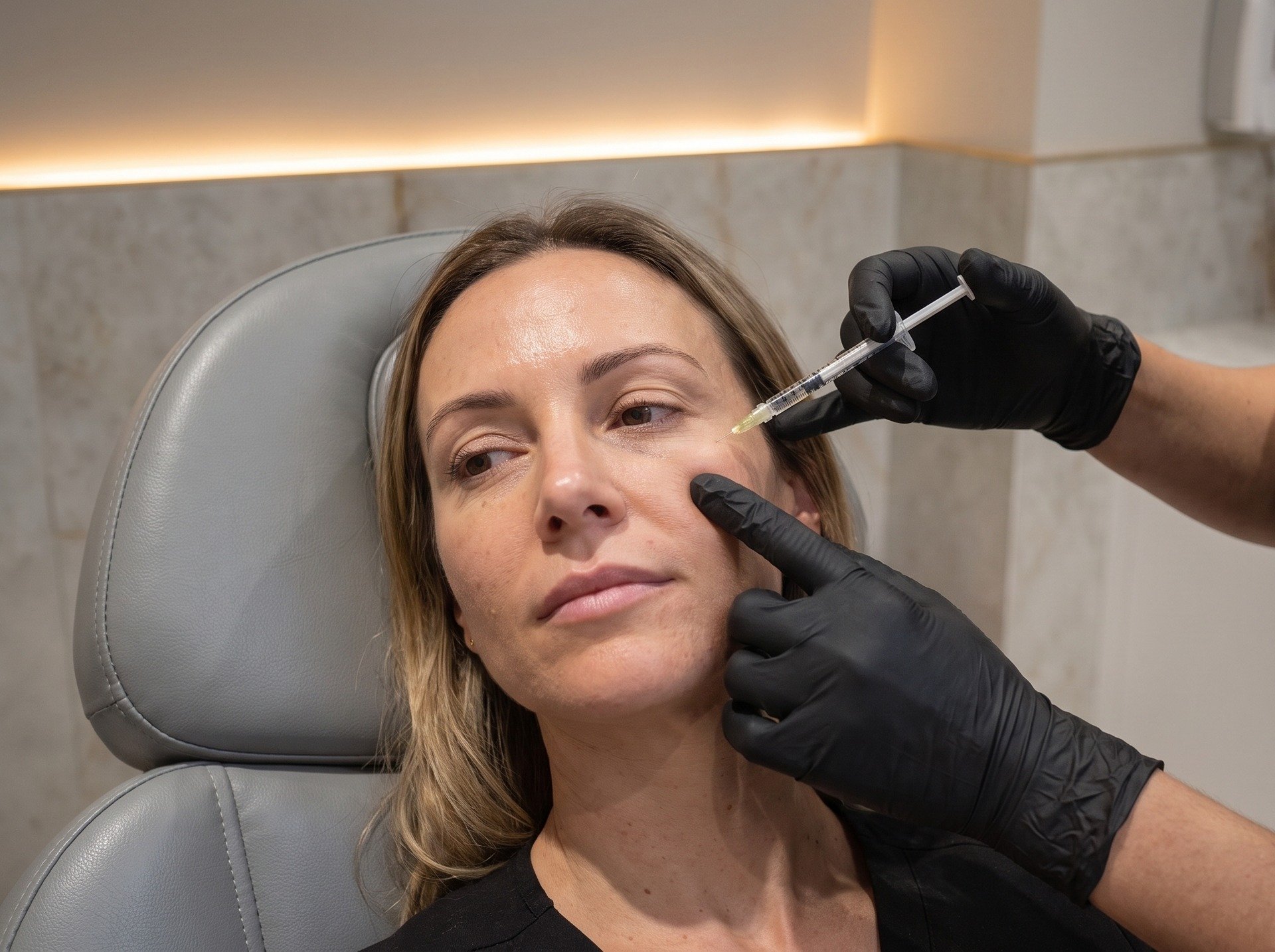
Dermal Fillers in Aventura: Which Filler for Which Area
TREATMENTS
Dermal Fillers in Aventura: Which Filler for Which Area
“Filler” is not one product. It is a category, and the difference between a natural result and an obvious one usually comes down to whether the right material was chosen for the right layer of the right area. A gel designed to sit softly in the lips behaves badly along a jawline; a firm gel built to project a chin looks wrong under the eyes. Here is how the families differ, what each area actually needs, and where the honest answer is “not filler at all.”
The three families, and what each one does
Almost everything offered as a “dermal filler” belongs to one of three groups.
Hyaluronic acid (HA) gels, Restylane, Juvéderm, VERSA, RHA. Hyaluronic acid is a sugar your skin already produces, manufactured here as a crosslinked gel that adds volume the moment it is placed. Its defining advantage is control: HA is the only family that can be dissolved on demand with hyaluronidase if the shape is not what you wanted, or if there is a complication.⁹ Within the family, gels vary enormously in firmness and lift, a soft, flexible gel for lip movement is a different product from the firm gel used to build a chin.
Calcium hydroxylapatite (CaHA), Radiesse. Microspheres of a calcium mineral suspended in a gel carrier. It gives immediate structure, but its more interesting effect is biological: the microspheres act as a scaffold that stimulates your own fibroblasts to lay down new collagen over the following months.² That makes it a biostimulator as much as a filler, used for structural areas and for skin quality where crepiness, not volume loss, is the complaint.
Poly-L-lactic acid (PLLA), Sculptra. PLLA adds almost no immediate volume. It works by provoking a controlled collagen response over a series of sessions, so the change appears gradually across two to three months and is measured in your collagen rather than in gel.³ ⁴ It suits diffuse facial thinning and body applications where a slow, global restoration reads more naturally than a filled compartment.
What the science says
The evidence base is strongest exactly where the decisions matter most:
- A multicenter randomized head-to-head trial of four HA fillers for lip augmentation found differences between products in outcome and in side-effect profile, confirming that “lip filler” is not a generic purchase.¹
- Reviews of CaHA describe a dual mechanism: immediate volume plus fibroblast activation and neocollagenesis, which is why its effect keeps developing after placement.²
- PLLA is characterized in the literature as a collagen stimulator whose result builds progressively and depends on correct reconstitution and injection technique.³ ⁴
- For the tear trough, systematic reviews report meaningful improvement, and a distinct pattern of delayed complications such as persistent swelling and Tyndall discoloration, driven by product choice and depth.⁵ ⁶
- The literature on vascular complications is unambiguous that risk is concentrated in specific danger zones (glabella, nose, nasolabial, periorbital), and that recognition and immediate hyaluronidase are what change outcomes.⁷ ⁸ ⁹
Which filler for which area
Lips. Soft, flexible HA gels that move with the mouth, Restylane Kysse and comparable products are built for this. The goal at consultation is usually definition and hydration rather than volume; product choice and the amount placed are what separate a lip that reads as yours from one that announces itself.¹ See lip fillers in Aventura.
Under eyes (tear trough). The most technically demanding area on the face. It requires a low-hydrophilic HA gel placed deep, on bone, in small volumes, and a candidate whose hollowing is genuinely volume loss rather than fluid retention, skin laxity or fat prolapse. When the anatomy is wrong for filler, the correct answer is to decline it.⁵ ⁶ See under-eye filler.
Cheeks and midface. Firm, high-lift HA gels or Radiesse for structure, and Sculptra when the issue is global thinning rather than a specific hollow. Restoring the midface often improves the nasolabial fold indirectly, treating the fold itself is frequently the wrong first move.
Jawline and chin. Projection needs a firm, high-G-prime product placed on bone. This is where a soft lip gel fails: it spreads instead of supporting. Radiesse and firm HA gels are the usual tools.
Nasolabial folds and marionette lines. Mid-firmness HA, ideally after the midface has been addressed.
Nose (liquid rhinoplasty). Possible, and one of the highest-risk areas in the face for vascular events, non-negotiably a physician-level decision.⁷ ⁸ See liquid rhinoplasty.
Hands. Radiesse restores the dorsal hand and softens visible tendons and veins.
Skin quality, not volume. SkinVive is a microdroplet HA injectable for smoothness and hydration of the cheek, it does not add contour, and it is the right answer when the complaint is texture rather than shape.
Is it safe? What can actually go wrong
Injected properly, by someone who knows the vascular anatomy, HA filler has a strong safety record, and it has an antidote, which most aesthetic procedures do not.⁹ The complications that matter are:
- Vascular occlusion, where product enters or compresses a vessel. It is rare, it is an emergency, and published guidelines exist precisely because rapid recognition plus high-dose hyaluronidase determines the outcome.⁸ ⁹
- Blindness, the rarest and most serious event, reported in the world literature almost entirely from high-risk zones, glabella, nose, forehead and periorbital.⁷
- Delayed swelling, nodules and Tyndall effect, most documented under the eyes and usually a product-choice or depth problem.⁵ ⁶
Practical consequence for you as a patient: ask which product is going in, in which plane, and whether the person injecting has hyaluronidase on site and a protocol to use it. At Lumini, hyaluronidase is available for both correction and emergency use.
When the honest answer is “not filler”
Filler restores volume and structure. It does not tighten loose skin, it does not resurface texture, and it cannot fix a heaviness caused by descent rather than deflation. Chasing those problems with more syringes is how faces end up overfilled. If your concern is laxity, energy-based tightening is the right lane; if it is texture or pigment, resurfacing is; if it is a heavy upper eyelid, that is a surgical conversation. A consultation that is willing to tell you “this is not a filler problem” is worth more than one that isn’t.
At Lumini Medical Spa (Aventura Mall)
We work with the HA fillers we stock, Restylane and VERSA, plus Radiesse and Sculptra as biostimulators, SkinVive for skin quality, and hyaluronidase for correction. Treatment starts with an exam: we map what is actually creating the change you see, choose the product and plane for that anatomy, and tell you plainly when the answer is a different treatment or none at all. Pricing is personalized, because the product and the number of syringes depend on your face and not on a package. Our team treats patients in English, Spanish and Portuguese, and we serve Aventura, Sunny Isles Beach, Bal Harbour, North Miami Beach and greater Miami.
Frequently asked questions
Which dermal filler lasts the longest? It depends on the material and where it is placed: HA gels commonly last from several months to about a year and a half depending on the product and the area, Radiesse builds collagen while it resorbs, and Sculptra’s result is your own collagen and can persist well beyond the injection series. Movement matters too, lips break product down faster than a chin.
What is the difference between Juvéderm and Restylane? Both are hyaluronic acid, made with different crosslinking technologies, which changes how firm, how flexible and how hydrophilic each gel is. That is why the choice is made per area and per anatomy rather than by brand loyalty, and why a good injector carries more than one line.¹
Are dermal fillers safe? For appropriate candidates, in trained hands, yes, with the important caveat that vascular complications exist and are managed by immediate recognition and hyaluronidase. Ask where the product is being placed and whether hyaluronidase is on site.⁷ ⁸ ⁹
Can filler be removed if I don’t like it? Hyaluronic acid can be dissolved with hyaluronidase. Radiesse and Sculptra cannot, which is exactly why they are placed conservatively and in the right patient.⁹
Do I need filler under my eyes? Often not. Under-eye hollowing has several causes, and only some of them are volume loss. When the cause is fluid, laxity or fat prolapse, filler makes it look worse, and we will tell you so.⁵ ⁶
Where can I get dermal fillers near Aventura Mall? Lumini Medical Spa is inside Aventura Mall, Suite 1954, minutes from Sunny Isles Beach, Bal Harbour and North Miami Beach, with consultations in English, Spanish and Portuguese.
References
- Steenen SA, Bauland CG, et al. Head-to-head comparison of 4 hyaluronic acid dermal fillers for lip augmentation: A multicenter randomized study. J Am Acad Dermatol. 2023. PMID: 36370906. https://pubmed.ncbi.nlm.nih.gov/36370906/
- van Loghem J. Calcium Hydroxylapatite in Regenerative Aesthetics: Mechanistic Insights and Mode of Action. Aesthet Surg J. 2025. PMID: 39365034. https://pubmed.ncbi.nlm.nih.gov/39365034/
- Christen MO. Collagen Stimulators in Body Applications: A Review Focused on Poly-L-Lactic Acid (PLLA). Clin Cosmet Investig Dermatol. 2022. PMID: 35761856. https://pubmed.ncbi.nlm.nih.gov/35761856/
- Fitzgerald R, Bass LM, et al. Physiochemical Characteristics of Poly-L-Lactic Acid (PLLA). Aesthet Surg J. 2018. PMID: 29897517. https://pubmed.ncbi.nlm.nih.gov/29897517/
- Trinh LN, Grond SE, et al. Dermal Fillers for Tear Trough Rejuvenation: A Systematic Review. Facial Plast Surg. 2022. PMID: 34192769. https://pubmed.ncbi.nlm.nih.gov/34192769/
- Trinh LN, McGuigan KC, et al. Delayed Complications following Dermal Filler for Tear Trough Augmentation: A Systematic Review. Facial Plast Surg. 2022. PMID: 34666405. https://pubmed.ncbi.nlm.nih.gov/34666405/
- Beleznay K, Carruthers JDA, et al. Update on Avoiding and Treating Blindness From Fillers: A Recent Review of the World Literature. Aesthet Surg J. 2019. PMID: 30805636. https://pubmed.ncbi.nlm.nih.gov/30805636/
- Murray G, Convery C, et al. Guideline for the Management of Hyaluronic Acid Filler-induced Vascular Occlusion. J Clin Aesthet Dermatol. 2021. PMID: 34188752. https://pubmed.ncbi.nlm.nih.gov/34188752/
- Kroumpouzos G, Treacy P. Hyaluronidase for Dermal Filler Complications: Review of Applications and Dosage Recommendations. JMIR Dermatol. 2024. PMID: 38231537. https://pubmed.ncbi.nlm.nih.gov/38231537/
Medically reviewed by Dr. Thiago Queiroz, D.O., Medical Director, Lumini Medical Spa. Educational, not a substitute for an in-person consultation.