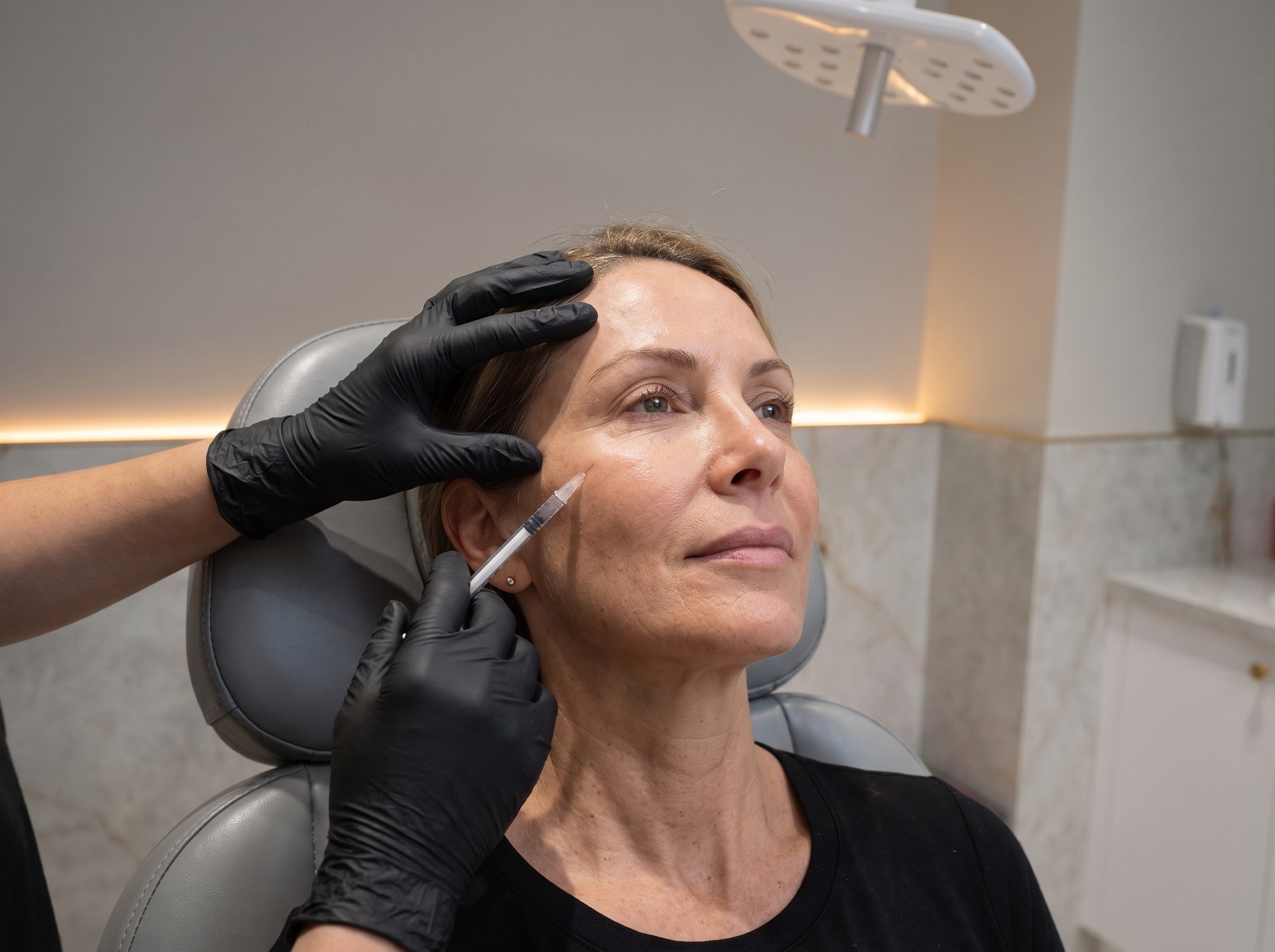
Sculptra vs. Radiesse: Which Biostimulator for Which Goal?
TREATMENTS
Sculptra vs. Radiesse: Which Biostimulator for Which Goal?
Both are called biostimulators, both are injected, and neither is a filler in the way most people mean the word, but Sculptra and Radiesse are not interchangeable. One asks your own tissue to build collagen slowly over months. The other supports the face today and biostimulates afterwards. Here’s how to tell which one your goal actually calls for, including the part of the research the marketing tends to leave out.
Neither one is a classic filler
A hyaluronic acid filler adds volume the moment it goes in: it’s a gel that holds water and occupies space. A biostimulator works differently, it’s a scaffold your body responds to, and the result you see months later is largely your own new collagen rather than the product itself. Sculptra is poly-L-lactic acid (PLLA). Radiesse is calcium hydroxylapatite (CaHA) microspheres suspended in a gel carrier. Same broad idea, two very different molecules, and two very different timelines.
Where the research disagrees, and why that’s the honest headline
This is the part worth reading slowly, because it’s the part you won’t find in a brochure. Two of the most-cited studies comparing how these molecules behave in tissue reach opposite conclusions.
A 2025 randomized comparative study biopsied the nasolabial fold in 21 subjects 90 days after injection. It reported that PLLA stimulated more extracellular matrix components with less inflammatory response, a regenerative pathway, while CaHA elicited a more inflammatory response.¹
A 2023 preclinical investigation exposed human macrophages to both materials in vitro and concluded the reverse: CaHA showed a non-inflammatory mode of action, while PLLA induced several inflammatory cytokines (CCL1, TNFRII, MIP-1α and IL-8).²
Now the disclosure neither press release leads with: the first paper includes authors connected to the maker of Sculptra, and the second comes from R&D at Merz Aesthetics, which makes Radiesse. The models differ too, human tissue at 90 days versus cells in a dish, which is exactly why neither one settles anything. When two studies funded from opposite sides contradict each other, the lesson isn’t that one of them won. The lesson is that a mechanism claim is the weakest possible reason to pick a product: the choice is made on your goal and your anatomy, not on marketing.
What isn’t in dispute: how each one behaves
Sculptra (PLLA) gives no meaningful immediate volume. What you see right after the session is mostly the injected fluid, and it settles within days. The real result builds gradually over months as collagen forms, which is why it’s done as a series of sessions spaced weeks apart rather than in a single visit. It suits diffuse volume loss and overall skin quality across larger areas, the generally deflated look that no single line explains.
Radiesse (CaHA) does two things at once: it provides support and lift immediately, and it biostimulates afterwards. That immediate structure makes it a strong candidate where contour is the goal, jawline definition, jowls, anywhere that needs a defined edge rather than diffuse softening.
Longevity is where honest answers get vague, and they should. Both materials are gradually resorbed by the body, and how long your result holds depends on the product, the amount used, the area treated and your own metabolism, published ranges run from several months to around a couple of years, and it varies from person to person. A precise number promised in advance is a marketing number, not a clinical one.
Hyperdilute Radiesse is a third tool, not a discount version
Diluting CaHA changes what it does. A 2026 review of hyperdilute calcium hydroxylapatite describes how the technique prioritizes neocollagenesis, neoelastogenesis and matrix remodeling across large areas, face and body, including the buttocks, arms and abdomen, while softening the immediate volumizing effect.³ In other words, the same product that defines a jawline at standard dilution becomes a skin-quality and laxity tool when hyperdiluted, including off the face. That’s a technique decision, and it belongs in the consultation.
Matching the goal to the molecule
As a starting map, not a rule: diffuse volume loss and skin quality over a broad area lean toward Sculptra; contour and definition you want supported right away lean toward Radiesse; crepey skin and mild laxity, on or off the face, point toward the hyperdilute technique. Often the honest answer is both, different molecules in different areas, or in sequence, for goals that no single product covers. None of that is decided from a blog post. It’s decided when a physician looks at your face.
Neither one is reversible, and that deserves a straight answer
If a hyaluronic acid filler goes wrong, or you simply change your mind, it can be dissolved with hyaluronidase in minutes. Sculptra and Radiesse cannot. There’s no eraser for PLLA or CaHA; both resorb on their own schedule over time. That isn’t a reason to avoid them, it’s the reason to be conservative with dose, deliberate with placement, and specific about who is injecting you. Biostimulators reward patience and punish improvisation.
At Lumini Medical Spa (Aventura Mall)
Every biostimulator plan here starts with a medical examination by Dr. Thiago Queiroz, D.O., our Medical Director, your anatomy, your history and your goal, before any product is named. From there we map the goal to the biostimulator, or to a combination of both, and we explain why. Pricing is personalized to your plan and confirmed at your consultation. Our team treats patients in English, Spanish and Portuguese.
Frequently asked questions
Which lasts longer, Sculptra or Radiesse? Both are gradually resorbed by the body. Published ranges run from several months to around a couple of years depending on the product, the amount used, the area and your metabolism, it varies from person to person, and an exact number promised before an exam is a guess. Which one gives faster results? Radiesse, by design: support and lift are visible immediately, and the biostimulation follows. Sculptra intentionally shows almost nothing at first, its result builds over months as your collagen forms. Can I combine Sculptra and Radiesse? Frequently, yes, different molecules in different areas, or used in sequence, when one product doesn’t cover the whole goal. Whether that fits you is decided at your consultation. Does it hurt? Both are done with topical numbing and comfort measures discussed beforehand; most people describe pressure more than pain. Temporary swelling, tenderness or bruising for a few days is normal. How many sessions will I need? Sculptra is typically a series of sessions spaced weeks apart, because the collagen builds between them. Radiesse is often a single session per area with maintenance later. Your number is confirmed at your consultation, not before it. Are they reversible? No, and this is an important difference. Unlike hyaluronic acid fillers, neither PLLA nor CaHA can be dissolved with hyaluronidase. They resorb naturally over time, which is precisely why dose, placement and the hands doing the injecting matter so much.
References
- Waibel J, Nguyen TQ, Le JHTD, Qureshi A, Ziegler M, Widgerow A, Meckfessel M. Gene Analysis of Biostimulators: Poly-L-Lactic Acid Triggers Regeneration While Calcium Hydroxylapatite Induces Inflammation Upon Facial Injection. J Drugs Dermatol. 2025. PMID: 39761144.
- Nowag B, Schäfer D, Hengl T, Corduff N, Goldie K. Biostimulating fillers and induction of inflammatory pathways: A preclinical investigation of macrophage response to calcium hydroxylapatite and poly-L lactic acid. J Cosmet Dermatol. 2023. PMID: 37593832.
- Soza GM. Hyperdilute Calcium Hydroxylapatite for Skin Quality and Contour: Clinical Applications, Technique, and Practical Considerations. Dermatol Clin. 2026. PMID: 42303355.
Medically reviewed by Dr. Thiago Queiroz, D.O., Medical Director, Lumini Medical Spa. This article is educational and not a substitute for an in-person medical consultation.