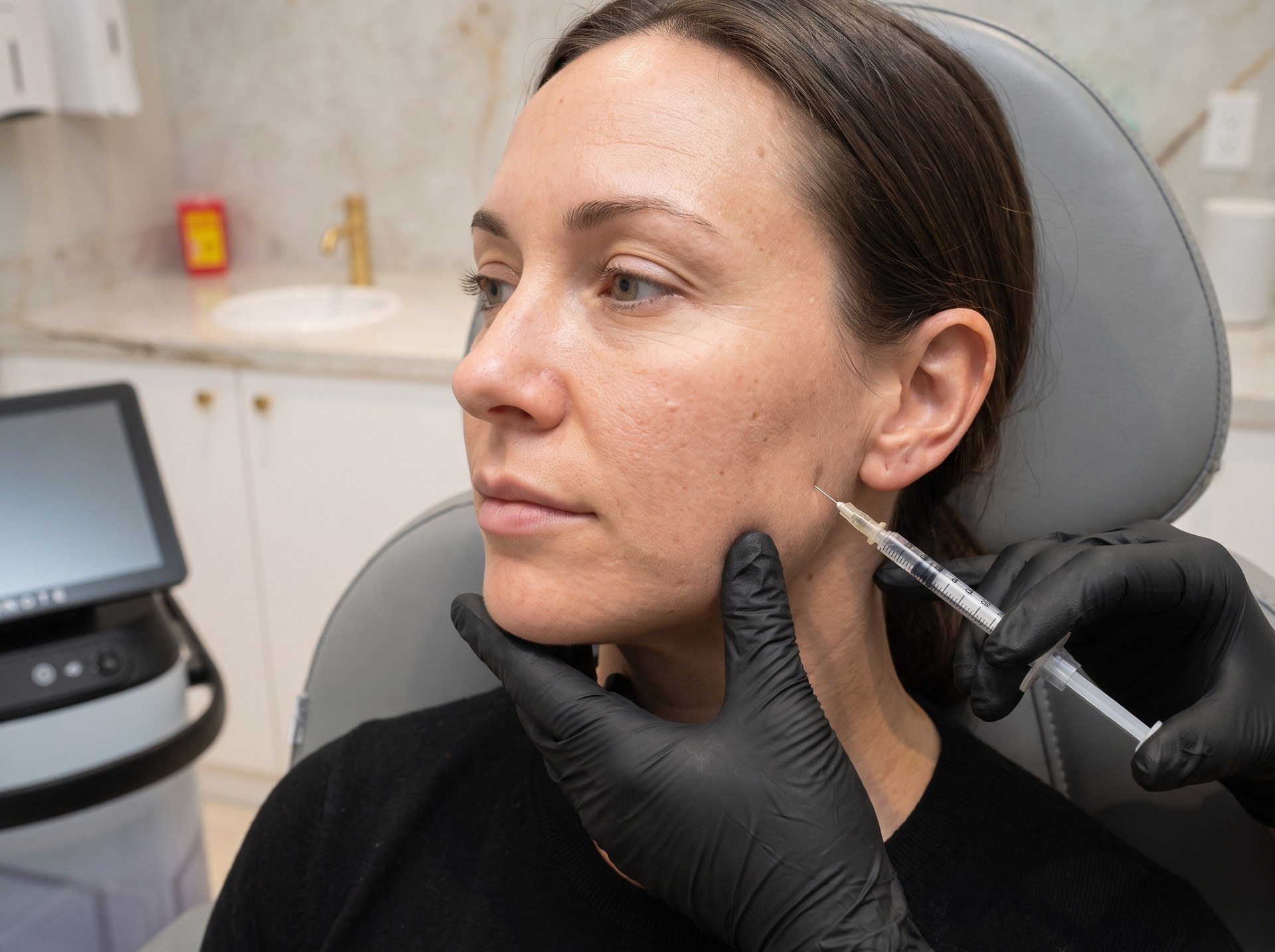
Masseter Botox: Jaw Slimming, TMJ & Bruxism
TREATMENTS
Masseter Botox: Jaw Slimming, TMJ & Bruxism
Softening a strong, square jawline and calming a sore, overworked jaw are two of the fastest-growing reasons patients ask us about Botox. The honest version: the contouring is well supported by research, and the jaw-pain story is far more nuanced. Here is what the evidence actually shows, so you arrive at your consultation already knowing what matters.
What masseter Botox actually is
The masseter is the thick, powerful muscle on each side of the jaw that closes your mouth when you bite and chew. A small, precisely placed amount of botulinum toxin type A partially relaxes it. Because the muscle then works less, it gradually loses volume over several weeks and the lower face reads softer and more tapered. Nothing is cut, and nothing is permanent.
Jaw slimming and masseter hypertrophy: the strongest evidence
This is the use with the best scientific support. A 2022 systematic review of 24 randomized trials concluded that there is good scientific evidence for botulinum toxin injections in masseter hypertrophy, the enlarged-muscle pattern behind a wide, square lower face.¹
A 2025 prospective trial using 30 units per side measured roughly a 60% reduction in muscle volume by six weeks, with pain scores down 80–100% and no serious adverse effects, only a transient mild bruise and some chewing fatigue.² One caveat we will state plainly: that study included just five patients, so read the exact percentages as encouraging rather than settled.
Newer work also uses ultrasound to guide the needle into the correct muscle layer and to measure masseter thickness before and after treatment, a sign the field is moving toward more precise, individually measured dosing rather than one-size-fits-all injections.⁵
TMJ pain and bruxism: an honest look at the evidence
Here the picture is much less certain, and we would rather say so up front. The same 2022 systematic review found the evidence only equivocal for muscle-related TMJ pain, and very limited for disorders of the jaw joint itself.¹
For bruxism specifically, a 2025 meta-epidemiologic study found spin bias in 59.4% of the randomized trials, results presented more favourably than the underlying data justified, and concluded that it is not currently possible to be certain about the efficacy or the safety of botulinum toxin for reducing pain and grinding events. Results for masseter injection specifically remain controversial.³
When Botox has been compared head-to-head with a simple occlusal splint (night guard) in 40 patients, both reduced pain and neither proved superior to the other; bite force also drops over the first two to six weeks and recovers within three to six months.⁴ So for clenching and grinding we treat Botox as something that may help pain in selected cases, discussed individually, never promised, and not an automatic first line ahead of a night guard.
How we approach it at Lumini
Every masseter treatment here starts with a medical examination by our Medical Director, Dr. Thiago Queiroz, D.O. Your dose is then mapped to your actual anatomy, muscle size, symmetry, bite pattern and your goals, because over-relaxing the masseter can affect chewing or change how your smile moves. No guarantees, no before-and-after theatre: a plan built for your face.
Onset, duration and chewing
Slimming is gradual by nature: most people notice a softer contour over six to twelve weeks, and the effect generally lasts three to six months before a maintenance session is considered.⁴ Chewing usually adapts within days; mild, temporary muscle fatigue while eating is the most commonly reported minor effect.² Because the effect wears off on its own, the decision is never irreversible.
Who is it for, and who is it not for
The best candidates are people whose lower face is wide because the muscle is genuinely enlarged, often long-term clenchers or gum chewers. If the width comes from bone structure or from facial fat, masseter Botox will not change it, and we will tell you that at the consultation rather than treat you anyway. If your main complaint is jaw pain or grinding, we will discuss the evidence above with you, along with a night guard and dental assessment, before anything is injected.
Frequently asked questions
Does masseter Botox really slim the jaw? For a jaw that is wide because the masseter muscle is enlarged, yes, this is the best-supported use, backed by a systematic review of 24 randomized trials, and a small prospective study measured about a 60% reduction in muscle volume at six weeks.¹² The change is gradual, not immediate. How long does it last? Usually three to six months before a maintenance session is considered; muscle strength has been shown to recover within three to six months after treatment.⁴ Does it hurt? The injection uses a very fine needle and takes a few minutes; most patients describe a brief pinch, and topical numbing is available on request. Will it affect my chewing or my smile? Mild, temporary chewing fatigue is the most commonly reported minor effect and settles on its own.² Dosing mapped to your anatomy is exactly how we avoid over-relaxing the muscle and altering your smile, which is why the medical exam comes first. Does it work for bruxism or TMJ pain? The evidence is mixed and remains controversial: reviews found it equivocal for muscle-related TMJ pain, 59.4% of bruxism trials carried spin bias, and a night guard performed just as well as Botox in a randomized comparison.¹³⁴ It may help pain in selected cases, which is a conversation for your consultation, not a promise. How much does it cost? Pricing is personalized to the number of units your muscles actually need and is confirmed at your consultation.
References
- Delcanho R, Val M, Guarda Nardini L, Manfredini D. Botulinum Toxin for Treating Temporomandibular Disorders: What is the Evidence? J Oral Facial Pain Headache. 2022. PMID: 35298571.
- Khan AM, et al. A Prospective Clinical Trial to Evaluate the Role and Efficacy of Botulinum Toxin Type-A for Masseter Muscle Hypertrophy. J Pharm Bioallied Sci. 2025. PMID: 41164594.
- De Luca Canto G, et al. Spin Bias in randomized controlled trials of botulinum toxin for bruxism management: a meta-epidemiologic study. BMC Med Res Methodol. 2025. PMID: 40340732.
- Kaya DI, Ataoglu H. Botulinum toxin treatment of temporomandibular joint pain in patients with bruxism: A prospective and randomized clinical study. Niger J Clin Pract. 2021. PMID: 33723117.
- Gerardi D, et al. The emerging role of ultrasound in facial aesthetic procedures. J Stomatol Oral Maxillofac Surg. 2026. PMID: 41539645.
Medically reviewed by Dr. Thiago Queiroz, D.O., Medical Director, Lumini Medical Spa. This article is educational and not a substitute for an in-person medical consultation.