Cherry Angiomas and Skin Tags: What They Are, When to Get Them Checked, and How Removal Works
Cherry Angiomas and Skin Tags: What They Are, When to Get Them Checked, and How Removal Works
Small red dots on the chest. A soft flap of skin on the neck that catches on a necklace. Cherry angiomas and skin tags are two of the most common growths adults notice, and two of the most searched. Both are usually benign. Neither one usually needs treatment for medical reasons. Many people still want them gone, because they bleed when scratched, snag on clothing or simply sit where they are seen every day.
At Lumini Medical Spa in Aventura, removal starts with an examination, not with the laser. This guide explains what each growth is, which signs mean a lesion needs a medical evaluation rather than a cosmetic appointment, what the evidence says about removal methods, and why at-home removers are a poor idea.
1. What a cherry angioma is
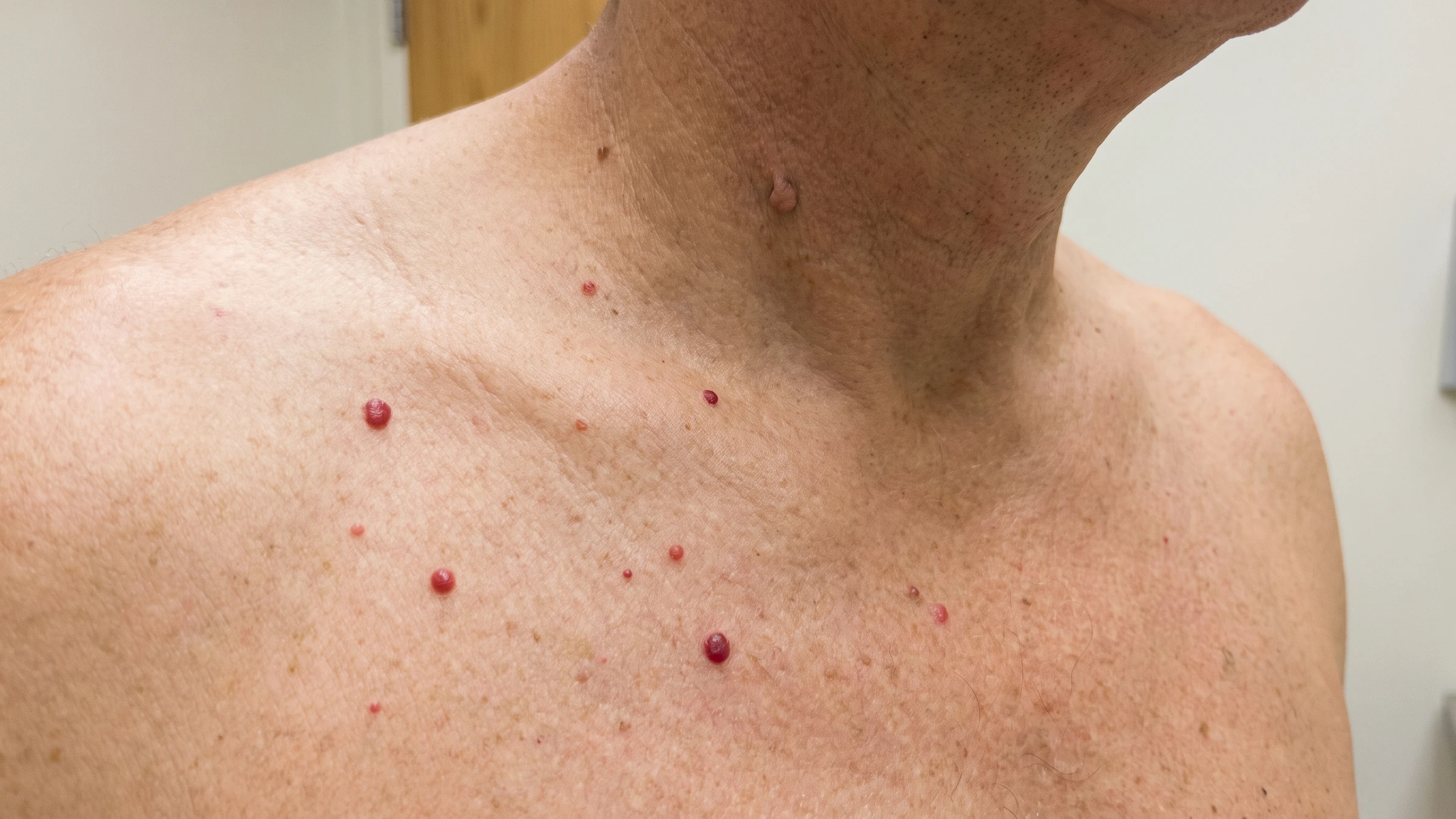
A cherry angioma (also called a cherry hemangioma, senile angioma or Campbell de Morgan spot) is a small cluster of dilated capillaries in the upper skin. It usually looks like a bright red to purple dome or flat dot, from pinpoint size to a few millimeters. The trunk and upper arms are typical locations, though they can appear almost anywhere.
They become more common with age, and many adults have several. They are made of blood vessels, not pigment cells, which is why they look red rather than brown. A cherry angioma may bleed if it is nicked while shaving or scratched, but it is not considered a cancer and is not thought to turn into one.
2. What a skin tag is
A skin tag (acrochordon) is a soft, skin-colored or slightly darker growth that often hangs from a thin stalk. Skin tags tend to form where skin rubs against skin or clothing: the neck, armpits, eyelids, under the breasts and the groin.
They are common in adults and are more frequent with higher body weight, in pregnancy and in people with insulin resistance. Several published studies have reported an association between multiple skin tags and insulin resistance. That does not mean a skin tag diagnoses diabetes. It does mean that someone with many new tags may reasonably mention it to their primary care physician, especially if other signs, such as darkened velvety skin on the neck (acanthosis nigricans), are present.
3. Signs that a spot needs medical evaluation first
The most important step happens before any removal: confirming that the growth is what it appears to be. Some lesions can resemble a cherry angioma or a skin tag and need a different pathway. Seek a medical or dermatologic evaluation, rather than a cosmetic removal, if a spot:
- is new and changing in size, shape or color
- is dark brown, black, multicolored or has an irregular border
- bleeds without being injured, crusts, or does not heal
- grows quickly or looks different from your other spots
- appears together with many new red spots over a short period
| What you notice | What it often is | Why it still needs a look |
|---|---|---|
| Smooth bright red dot or dome | Cherry angioma | Some red or bleeding lesions are not angiomas; a fast-growing, easily bleeding red bump needs evaluation |
| Soft flap on a thin stalk | Skin tag | A pigmented, firm or changing “tag” may be a different lesion |
| A sudden crop of many new red spots | Possibly eruptive cherry angiomas | Eruptive angiomas have been reported with certain medications and medical conditions; discuss with a physician |
| Brown, rough, “stuck-on” spot | Often a seborrheic keratosis | Diagnosis is clinical; anything atypical goes to dermatologic evaluation |
A photograph cannot settle these distinctions. In our practice, our medical team examines each lesion in person; skin tags, seborrheic keratoses and similar benign growths can be candidates for removal, and anything with atypical features is referred for dermatologic evaluation instead of being treated.
4. How cherry angiomas are removed, and what the evidence shows
A 2020 systematic review in Dermatologic Surgery found ten studies supporting both laser and non-laser treatments for cherry angiomas. Light-based options included pulsed dye laser (PDL), potassium-titanyl-phosphate (KTP), the 1064 nm Nd:YAG laser and intense pulsed light. Non-laser options included electrosurgery, cryotherapy and sclerotherapy. The review’s honest conclusion: no single method proved superior, and high-quality comparative studies are limited.
Two practical findings matter for patients:
- Skin tone changes the choice. The review noted that the 1064 nm Nd:YAG laser produced fewer pigmentary complications, while KTP and PDL carried a higher risk of pigment change in darker skin.
- Every method has trade-offs. In a side-by-side comparison of KTP and Nd:YAG on cherry angiomas in the same patients, Nd:YAG needed fewer sessions but caused more redness, swelling, pain and scarring. KTP caused more hyperpigmentation. The authors suggested Nd:YAG may be preferable in darker-skinned patients.
That is why the plan depends on the size of the angioma, its location, your skin type and your tolerance for downtime. The number of sessions varies, and larger angiomas are more likely to need more than one.
5. How skin tags are removed
Common medical methods include snip excision, cryotherapy, electrosurgery and laser removal. Each removes the tag itself. None prevents new tags from forming elsewhere. The best method depends on the tag’s size and stalk, its location (eyelid tags need particular care) and your skin type, because any method that injures the skin can leave a small light or dark mark, particularly in medium-to-deep skin tones.
A removed tag usually does not grow back in the same place, but it can, especially if it was not removed completely. New ones can also appear, especially in friction-prone areas.
6. Why at-home removers are a bad idea
Creams, acids, bands, patches and so-called black salves are sold online as quick fixes. The U.S. Food and Drug Administration has sent warning letters to companies selling mole and skin-tag removers as unapproved drugs. In those letters the agency notes that skin damage from black-salve-type products is well documented, and that self-diagnosis and self-treatment of moles can delay a cancer diagnosis. A few home freezing devices are FDA-cleared for certain skin tags, but no home product can tell you whether the growth is benign.
That second problem matters most. Destroying a lesion before anyone has examined it can remove the evidence a biopsy would need. Have a clinician look first.
7. What removal is like
For most small benign lesions, removal is a short, in-office procedure:
- Comfort: a topical or local anesthetic may be used, depending on the lesion.
- Right after: mild redness and swelling are expected. A small scab may form and shed as the skin heals.
- Healing: keep the area clean and protected as instructed, and avoid picking. Healing time varies with the lesion and the method, and a pink or slightly lighter or darker mark may take longer to settle.
- Sun: Miami sun matters. Protect treated skin with clothing or broad-spectrum sunscreen to lower the risk of post-inflammatory hyperpigmentation.
Possible side effects include temporary redness, swelling, crusting, pigment change and, less commonly, a scar or incomplete clearance requiring another session. Your clinician should discuss these with you before treatment.
8. At Lumini Medical Spa (Aventura Mall)
At Lumini, benign lesion removal begins with an in-person assessment under the supervision of our Medical Director. Lesions that look benign and typical, such as skin tags, seborrheic keratoses and cherry angiomas, can be candidates for removal with our Fotona laser platform, which combines the Er:YAG (2940 nm) and Nd:YAG (1064 nm) wavelengths. Anything with atypical features is referred for dermatologic evaluation instead.
If your concern is diffuse facial redness or broken capillaries rather than isolated spots, see our vein and redness treatment page. For brown spots and melasma, start with our guide to melasma and dark spots. For visible veins on the legs, read about sclerotherapy for spider veins.
We do not quote prices or session counts before an examination. Pricing is personalized at your consultation.
9. Frequently asked questions
Are cherry angiomas cancerous?
Cherry angiomas are benign vascular growths and are not considered cancerous. Some other lesions can look similar, which is why a new, changing or bleeding red bump should be examined rather than assumed to be an angioma.
Why am I suddenly getting more cherry angiomas?
They become more common with age, and many people notice new ones gradually. A sudden crop of many new angiomas has been reported in association with some medications and medical conditions. It is worth mentioning to a physician rather than treating it as purely cosmetic.
Are skin tags a sign of diabetes?
Not on their own. Studies have associated multiple skin tags with insulin resistance and higher body weight, but a skin tag is not a diagnosis. If you have many new tags, or tags along with darkened velvety skin, discuss screening with your primary care physician.
Can I remove a skin tag myself?
It is not recommended. The FDA has acted against unapproved mole and skin-tag removers, and any home removal skips the step of confirming that the growth is benign.
Will a removed cherry angioma or skin tag come back?
Usually not, but it can happen, particularly when a lesion was not removed completely. New angiomas and skin tags can also form elsewhere over time.
Is laser removal safe for darker skin tones?
It can be, with the right wavelength and settings. Published evidence suggests the longer 1064 nm Nd:YAG wavelength carries a lower risk of pigment change than shorter wavelengths in darker skin. Any procedure can still cause temporary or lasting pigment change, so suitability should be assessed in person.
10. References
- Buslach N, Foulad DP, Saedi N, Mesinkovska NA. Treatment Modalities for Cherry Angiomas: A Systematic Review. Dermatologic Surgery. 2020;46(12):1691–1697. PMID: 33252464. https://pubmed.ncbi.nlm.nih.gov/33252464/
- Pancar GS, et al. Comparison of the 532-nm KTP and 1064-nm Nd:YAG lasers for the treatment of cherry angiomas. Journal of Cosmetic and Laser Therapy. 2011;13(4):138–141. PMID: 21689029. https://pubmed.ncbi.nlm.nih.gov/21689029/
- Cherry Hemangioma. StatPearls. PMID: 33085354. https://pubmed.ncbi.nlm.nih.gov/33085354/
- Skin Tag (Acrochordon). StatPearls. PMID: 31613504. https://pubmed.ncbi.nlm.nih.gov/31613504/
- Association of acanthosis nigricans and skin tags with insulin resistance. Anais Brasileiros de Dermatologia. 2012. PMID: 22481657. https://pubmed.ncbi.nlm.nih.gov/22481657/
- FDA. Warning letter to HaloDerm, Inc. (MARCS-CMS 608852), October 6, 2020: unapproved mole and skin tag removal products. https://www.fda.gov/inspections-compliance-enforcement-and-criminal-investigations/warning-letters/haloderm-inc-608852-10062020
- American Academy of Dermatology. Skin tags: Why they develop, and how to remove them. https://www.aad.org/public/diseases/a-z/skin-tags
- American Academy of Dermatology. What to look for: ABCDEs of melanoma. https://www.aad.org/public/diseases/skin-cancer/abcdes-melanoma
Medically reviewed by Dr. Caio Trentin, M.D., review date 2026-10-19. Educational information only. It does not replace an in-person assessment. Individual results vary.