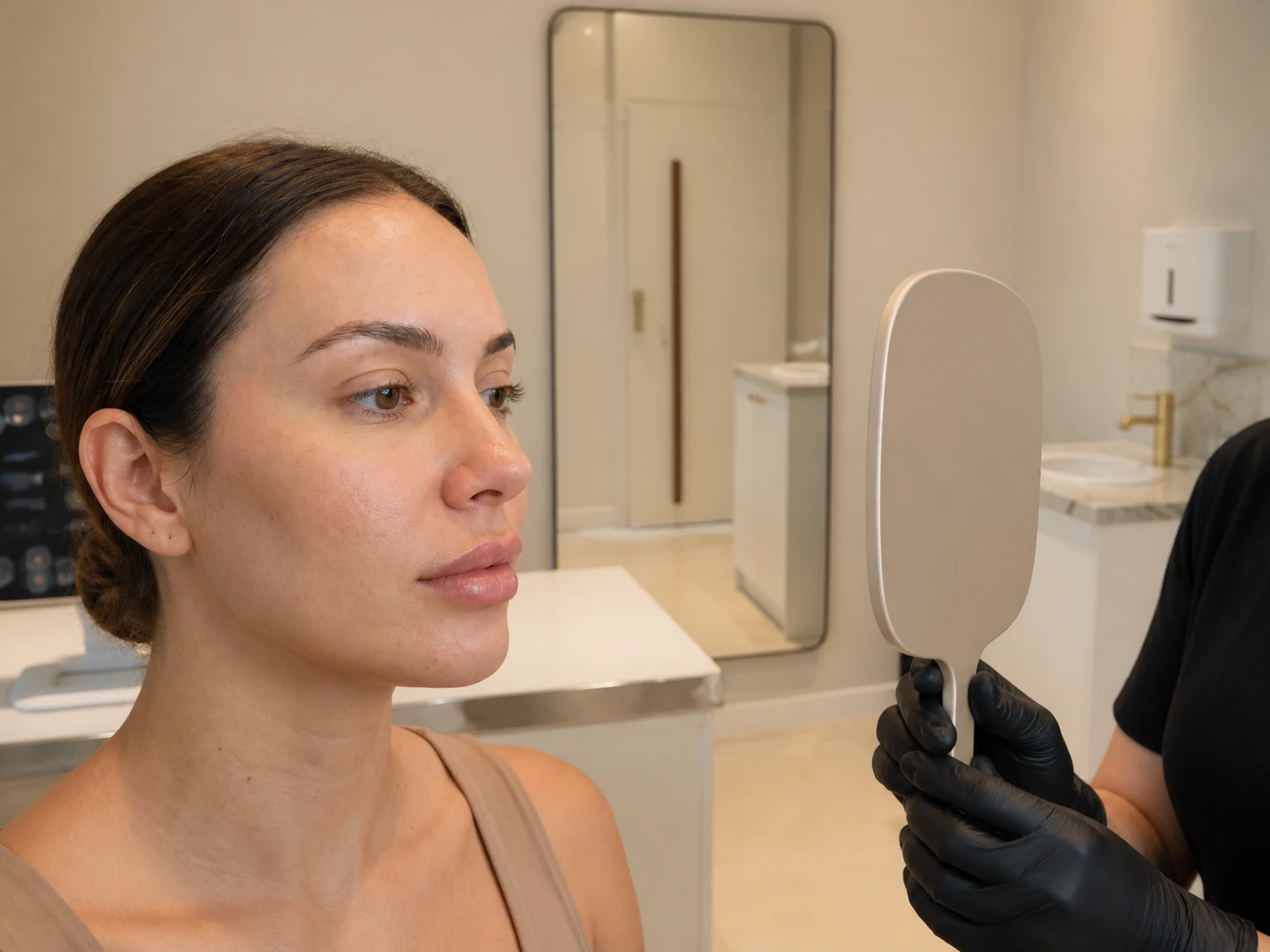
Lip Filler Migration: Signs, Causes, Prevention, and Correction
How to distinguish expected swelling from suspected migration, why evaluation matters, and when correction or urgent care may be appropriate.
Lip Filler Migration: Signs, Causes, Prevention, and Correction
Lip filler migration means filler material is suspected to have moved beyond the area where it was intended to remain. It may create fullness above the lip border, blur the vermilion edge, produce asymmetry or contribute to a contour that no longer matches the original plan. Early swelling or asymmetry is not automatically filler migration.
A photograph alone cannot confirm the diagnosis. The product used, injection date, amount, placement, previous treatments and physical examination all matter. When the history is unclear or the examination is inconclusive, ultrasound may help identify filler location and guide treatment in selected cases.
What lip filler migration means
The U.S. Food and Drug Administration lists migration as a reported risk of dermal fillers. Migration is different from a result that is simply fuller than expected, temporary post-injection swelling or a lump caused by another process.
The distinction matters because these findings do not have the same cause or treatment. A clinician must consider whether the visible change represents edema, product placement, a nodule, inflammation, infection, scar tissue, a delayed reaction or suspected movement of filler beyond the intended boundary.
Migration, swelling and nodules are not the same
| Finding | Typical pattern | Why evaluation matters |
|---|---|---|
| Expected swelling or bruising | Often begins soon after treatment and changes during the early recovery period | It can temporarily distort the lip border and create asymmetry without representing migration |
| Placement-related contour | May be visible or palpable in the treated area after swelling settles | Product depth, volume and anatomy affect whether observation or correction is appropriate |
| Nodule or firmness | A localized lump that may be early or delayed, tender or non-tender | Possible causes include product accumulation, inflammation, infection or a foreign-body response |
| Suspected migration | Fullness or product appears beyond the intended treatment boundary | The filler type, location, timing and prior treatments determine the available options |
| Possible vascular complication | Severe or increasing pain, blanching, dusky or mottled skin, visual symptoms or neurologic changes | This is time-sensitive and requires urgent assessment; it is not a routine migration concern |
Swelling, tenderness, firmness and bruising are among the most frequently reported reactions after hyaluronic acid lip filler in clinical studies. A contour concern during this period should be interpreted in the context of timing rather than labeled from appearance alone.
Why lip filler may appear to migrate
There is rarely one visible clue that identifies a single cause. Clinical reviews describe several factors that may influence filler complications and outcomes:
- Product and material: Hyaluronic acid fillers differ in gel properties, cohesivity and behavior in moving tissue. Permanent and non-hyaluronic acid fillers behave differently and cannot be assumed to have the same correction pathway.
- Volume and treatment plan: More volume can place greater demands on a small, mobile anatomical space. Conservative staging may make the result easier to assess before additional product is placed.
- Injection plane and anatomy: The lips contain vessels, muscle, mucosa, fat and connective tissue within a compact region. Product depth and relation to the vermilion border matter.
- Previous filler: Repeated treatment or an incomplete product history can make it difficult to know what material remains and where it is located.
- Tissue movement and pressure: Lips move constantly. Mechanical forces may affect contour, but current evidence does not support blaming a single activity for every case of suspected migration.
- Inflammation or another complication: A delayed inflammatory reaction, edema or nodule may resemble migration and requires a different assessment.
These factors describe possibilities, not a way to predict an individual result. No technique or product can reduce filler risk to zero.
What does lip filler migration look or feel like?
People commonly describe a ridge or fullness above the upper-lip border, a less defined vermilion edge, unexpected projection, asymmetry or a palpable area outside the intended contour. The appearance may be called a “filler mustache” online, but that label is not a medical diagnosis.
Similar findings can be caused by swelling, filler placed superficially, excessive volume, a nodule or pre-existing anatomy. Lighting, makeup and camera angle can also change how the border looks. An in-person assessment is more reliable than trying to diagnose migration from a selfie.
Can lip filler migration go away on its own?
Some hyaluronic acid filler is gradually broken down by the body, but the timing is variable and visible contour concerns do not resolve on a predictable schedule. Waiting may be reasonable when the finding is consistent with early swelling or when a stable, minor irregularity is not causing symptoms. Persistent, changing or concerning findings should be examined rather than managed according to a fixed internet timeline.
Permanent fillers and non-hyaluronic acid products may persist and can be difficult or impossible to remove completely. This is one reason the exact product history matters before any correction is attempted.
How suspected migration is evaluated
An evaluation starts with the filler name, treatment dates, approximate amounts, injection sites, prior dissolving treatments and any symptoms such as pain, warmth, color change or tenderness. The clinician then examines the lip at rest and with movement and palpates the relevant tissue.
Ultrasound can be useful when product identity or location is uncertain, when previous treatments overlap or when a complication needs more precise assessment. It is an adjunct, not a requirement for every patient. The goal is to identify the most likely problem before adding more filler or attempting reversal.
How lip filler migration is corrected
Correction depends on what is found:
- Observation: Appropriate when the contour is likely related to early swelling or when a stable finding does not require intervention.
- Hyaluronidase: This enzyme may be used to reduce hyaluronic acid filler when clinically indicated. The amount, placement and need for staged treatment depend on the product and tissue findings.
- Treatment of another complication: Infection, delayed inflammation, nodules and vascular problems require cause-specific management rather than a generic dissolving plan.
- Referral or procedural removal: Non-hyaluronic acid and permanent fillers are not dissolved by hyaluronidase. Selected cases may need specialist evaluation, and complete removal may not be possible.
Hyaluronidase is not a risk-free eraser. It can produce an incomplete or uneven correction, may require more than one session and can cause adverse reactions. Filler should never be dissolved or manipulated at home. After correction, the tissue should be reassessed before deciding whether or when another filler treatment is appropriate.
When symptoms need urgent care
Suspected migration is usually discussed as a contour or placement concern. Vascular occlusion is different and time-sensitive. Severe or increasing pain, skin blanching, a dusky or mottled pattern, cool skin, any visual disturbance, weakness, speech difficulty or another neurologic symptom after filler requires immediate emergency evaluation.
Do not wait for a routine appointment or attempt massage when these warning signs are present. FDA safety information notes that inadvertent injection into a blood vessel can cause tissue necrosis, blindness or stroke.
How to reduce the risk of lip filler complications
- Choose a licensed medical provider who evaluates lip and facial anatomy rather than selling a syringe without assessment.
- Disclose every previous filler, dissolving treatment and complication, including products placed elsewhere or years earlier.
- Confirm the exact product and whether it is appropriate for the planned site.
- Use a conservative, anatomy-based plan and stage treatment when that provides better control.
- Follow the treating clinician’s aftercare instructions and report unusual pain, color change, warmth, drainage or visual symptoms immediately.
- Make sure the practice has a plan for recognizing and managing filler complications.
The objective is not simply to avoid visible migration. It is to obtain an appropriate result while preserving tissue health and responding quickly if a complication occurs.
Lip filler assessment at Lumini Medical Spa
Lumini evaluates the existing contour, treatment history, tissue behavior and current goal before recommending observation, hyaluronidase or another plan. An assessment does not assume that every ridge, asymmetry or swollen lip is migrated filler.
Patients can review our lip filler treatment page, hyaluronidase treatment page, guide to dissolving filler, natural lip filler guide and dermal filler guide before scheduling. Lumini Medical Spa is located inside Aventura Mall. Contact Lumini to arrange an in-person assessment.
Frequently asked questions
Can lip filler migration go away on its own?
Hyaluronic acid filler can gradually break down, but the timing and visible improvement are unpredictable. Early swelling may resolve without intervention; persistent contour changes should be assessed before deciding to wait or dissolve.
Is swelling the same as lip filler migration?
No. Swelling is a common early reaction and may temporarily blur the lip border or create asymmetry. Migration refers to suspected filler beyond the intended treatment area. Timing, examination and treatment history help distinguish them.
Can lip filler migrate years later?
A delayed contour change can be noticed long after treatment, but appearance alone cannot establish when or why it developed. Residual filler, repeated treatments, tissue change, edema, nodules and inflammatory reactions may produce overlapping findings.
Can all migrated filler be dissolved?
No. Hyaluronidase acts on hyaluronic acid filler. It does not dissolve calcium hydroxylapatite, poly-L-lactic acid, polymethylmethacrylate or other non-hyaluronic acid materials. Product identification is important before treatment.
Does massage fix lip filler migration?
Massage is not a universal treatment and may be inappropriate when the cause is unknown. Do not aggressively manipulate a painful, discolored, warm or swollen area. Follow instructions from the clinician who has evaluated it.
When is a filler problem an emergency?
Any visual change, severe or escalating pain, skin blanching, dusky or mottled discoloration, coolness, weakness, speech difficulty or another neurologic symptom requires immediate emergency evaluation.
Can lip filler be replaced after dissolving?
Sometimes, but not automatically or immediately. The clinician should first confirm why correction was needed, allow the tissue to settle when appropriate and decide whether a different product, volume, plane or no additional filler is the safer plan.
References
- U.S. Food and Drug Administration. Dermal Fillers (Soft Tissue Fillers): uses, risks and safety information. https://www.fda.gov/medical-devices/aesthetic-cosmetic-devices/dermal-fillers-soft-tissue-fillers
- Safran T, Swift A, Cotofana S, Nikolis A. Evaluating safety in hyaluronic acid lip injections. Expert Opinion on Drug Safety. 2021;20(12):1473-1486. PMID: 34328377. https://pubmed.ncbi.nlm.nih.gov/34328377/
- Diwan Z, Trikha S, Evasan A, et al. Evaluation of current literature on complications secondary to lip augmentation following dermal filler injection. Journal of Clinical and Aesthetic Dermatology. 2023;16(7). PMID: 37560504. https://pubmed.ncbi.nlm.nih.gov/37560504/
- Signorini M, Liew S, Sundaram H, et al. Global Aesthetics Consensus: avoidance and management of complications from hyaluronic acid fillers—evidence- and opinion-based review and consensus recommendations. Plastic and Reconstructive Surgery. 2016;137(6):961e-971e. PMID: 27219265. https://pubmed.ncbi.nlm.nih.gov/27219265/
- Edward Wen Y, Thompson E, Ross N, et al. Efficacy and safety of hyaluronic acid lip fillers: a systematic review and meta-analysis of randomized controlled trials. Aesthetic Surgery Journal. 2026. PMID: 41186199. https://pubmed.ncbi.nlm.nih.gov/41186199/
- Cooper H, Gray D, Fronek L. Lip augmentation with hyaluronic acid fillers: a review of considerations and techniques. Journal of Drugs in Dermatology. 2023;22(1). PMID: 36607750. https://pubmed.ncbi.nlm.nih.gov/36607750/
- Kyriazidis I, Ghaly L, Karam M, et al. Adverse events associated with hyaluronic acid filler injection for non-surgical facial aesthetics: a systematic review of high-level evidence studies. Aesthetic Plastic Surgery. 2024;48. PMID: 37563436. https://pubmed.ncbi.nlm.nih.gov/37563436/
Medically reviewed by Dr. Caio Trentin, M.D., Physician, Lumini Medical Spa. Educational information only. It does not replace an in-person assessment. Individual results vary.