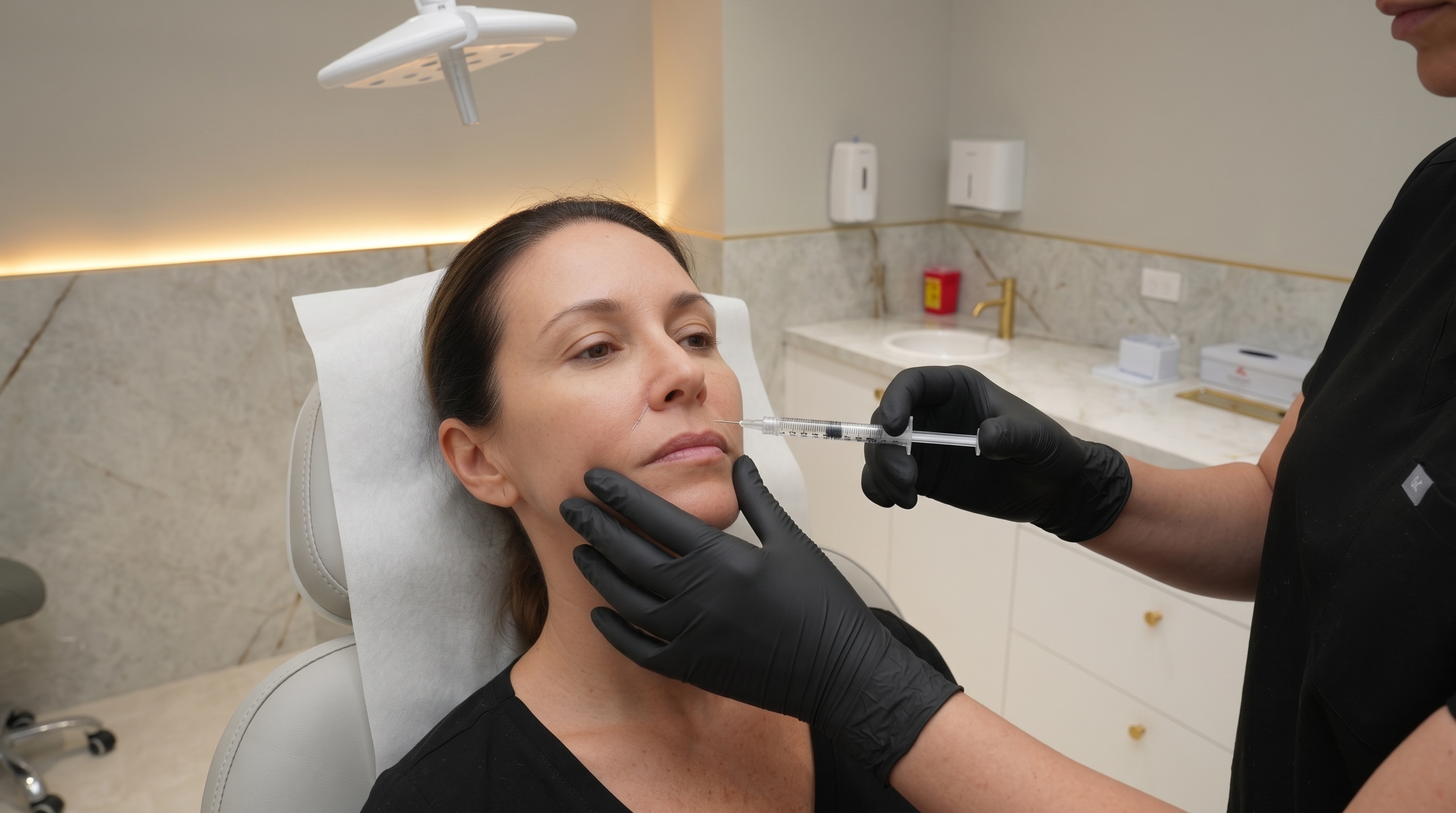
Nasolabial Folds in Aventura: Filler, Midface Support, or Leave Them?
TREATMENTS
Smile lines: treat the crease, or the cheek that creates it?
Nasolabial folds — the lines from the nose to the corners of the mouth — are often a midface problem first, not a crease that simply needs more gel. Filling the fold directly can soften a shadow. It can also make the lower face look heavier if the cheek has already descended. The better first question is what is creating the fold: volume loss higher up, skin quality, animation, or all three.
That is why this guide does not start with a product name. It starts with anatomy, then compares hyaluronic-acid support in the midface, conservative filler in the fold itself, collagen biostimulators, energy-based tightening, and the option of leaving the crease alone. Individual results vary. No plan is confirmed without an in-person exam at Lumini Medical Spa inside Aventura Mall.
What nasolabial folds actually are
The nasolabial fold is a normal facial landmark. It becomes more visible when the malar fat pad loses projection, the skin thins, or the muscle that lifts the upper lip keeps folding the same crease. South Florida sun accelerates the skin-quality part of that picture. A line that photographs well at 28 can read as tired at 45 even when the rest of the face still looks like itself.
Marionette lines — the downward creases from the mouth corners toward the jaw — often travel with the same midface change. Treating one without looking at the other is how faces end up “fixed” in one spot and heavier next door. See our area-by-area filler guide for how product families differ, and Sculptra vs. Radiesse when the question is collagen rather than gel.
| What you notice | What may be driving it | Why it changes the plan |
|---|---|---|
| A shadow from nose to mouth that deepens when you smile | Normal animation plus some volume shift | A static crease and a smile crease are not the same problem |
| The fold is deep even at rest, and the cheek looks flatter | Midface deflation or descent | Supporting the cheek may soften the fold without filling it |
| The crease is a thin etched line in otherwise full cheeks | Skin quality, sun, or a true dermal crease | Energy-based remodeling or a very small HA placement may fit better than a large syringe |
| Mouth corners pull down and the jaw looks heavier | Marionette complex, jowl, or depressor activity | Fold-only filler can widen the lower face |
| Previous filler sits in a ridge or looks puffy when you smile | Product in the wrong plane, or too much product in the crease | The first step may be hyaluronidase, not more gel |
Option 1: support the midface first
When the cheek has lost projection, the nasolabial fold is often a shadow cast from above. A firm hyaluronic-acid gel or Radiesse placed on the deep midface can restore that support so the crease reads softer without being stuffed. Sculptra belongs here when the change is global thinning rather than one hollow, because the result is your own collagen over a series of sessions, not an immediate gel ridge.
This is the plan we recommend discussing first for patients who say “I just want the smile lines gone” and then, on exam, have a flattened malar mound. Filling the fold in that face can make the lower third look busier. Individual results vary, and midface support is still a medical procedure with vascular risk that must be mapped on your anatomy.
Option 2: conservative filler in the fold itself
Direct hyaluronic-acid placement in the nasolabial fold still has a place: a true dermal crease in a cheek that already has adequate projection, or a residual shadow after the midface has been addressed. Mid-firmness HA is the usual tool. Soft lip gels spread. Overly firm gels can ridge when you speak.
The nasolabial region is also a documented vascular danger zone. Reviews of filler-related blindness and vascular occlusion concentrate events in the glabella, nose, nasolabial fold and periorbital area. That is not a reason to avoid treatment in trained hands. It is a reason to ask which product, which plane, and whether hyaluronidase is on site.1,2
Option 3: leave the crease — or treat skin, not volume
Some folds are simply how the face moves. Softening every smile line can look odd because the face is supposed to fold when you laugh. If the crease is mild, if previous filler already sits there, or if laxity rather than deflation is the driver, the honest answer may be no filler. Lasers and radiofrequency can help texture and mild laxity; they do not replace a descended fat pad. Threads can reposition selected tissue; they are not a substitute for midface volume. See threads vs. filler for the jawline when the lower face, not the crease, is the real complaint.
How we decide at Lumini
The consult is an exam, not a menu. We look at the cheek, fold, mouth corners and jawline together, in motion and at rest, under the same bright South Florida light that your neighbors see you in. Then we say whether the first move is midface support, a small amount of HA in the crease, a biostimulator series, hyaluronidase of old product, or nothing. Pricing is confirmed at that visit because the product and the number of syringes depend on your face.
Frequently asked questions
Should nasolabial folds be filled directly? Not automatically. If the cheek has lost support, treating the midface first often softens the fold more naturally than placing gel in the crease.
What is the difference between smile lines and marionette lines? Smile lines run from the nose toward the mouth. Marionette lines run from the mouth corners toward the jaw. They often appear together and should be planned together.
Can Sculptra or Radiesse treat nasolabial folds? They can belong in a midface or collagen-support plan. They are not interchangeable with a soft HA placed in the crease, and neither can be dissolved the way HA can.
Is filler in the nasolabial fold dangerous? It is a medical procedure in a higher-risk vascular territory. In trained hands, with the right product and plane and with hyaluronidase available, it is performed routinely. It is not a casual add-on.
How much does nasolabial fold treatment cost in Aventura? Pricing is personalized because the product, plane and number of syringes depend on your anatomy. It is confirmed at consultation.
Will I look overfilled? That is the risk of chasing the crease. Conservative, anatomy-led plans aim for a softer shadow, not a filled trench. Individual results vary.
References
- Beleznay K, Carruthers JDA, et al. Update on Avoiding and Treating Blindness From Fillers: A Recent Review of the World Literature. Aesthet Surg J. 2019. PMID: 30805636. PubMed.
- Murray G, Convery C, et al. Guideline for the Management of Hyaluronic Acid Filler-induced Vascular Occlusion. J Clin Aesthet Dermatol. 2021. PMID: 34188752. PubMed.
- Kroumpouzos G, Treacy P. Hyaluronidase for Dermal Filler Complications: Review of Applications and Dosage Recommendations. JMIR Dermatol. 2024. PMID: 38231537. PubMed.
- van Loghem J. Calcium Hydroxylapatite in Regenerative Aesthetics: Mechanistic Insights and Mode of Action. Aesthet Surg J. 2025. PMID: 39365034. PubMed.
- Christen MO. Collagen Stimulators in Body Applications: A Review Focused on Poly-L-Lactic Acid (PLLA). Clin Cosmet Investig Dermatol. 2022. PMID: 35761856. PubMed.
Medically reviewed by Dr. Caio Trentin, M.D., Physician, Lumini Medical Spa. Educational information only. It does not replace an in-person assessment. Individual results vary.